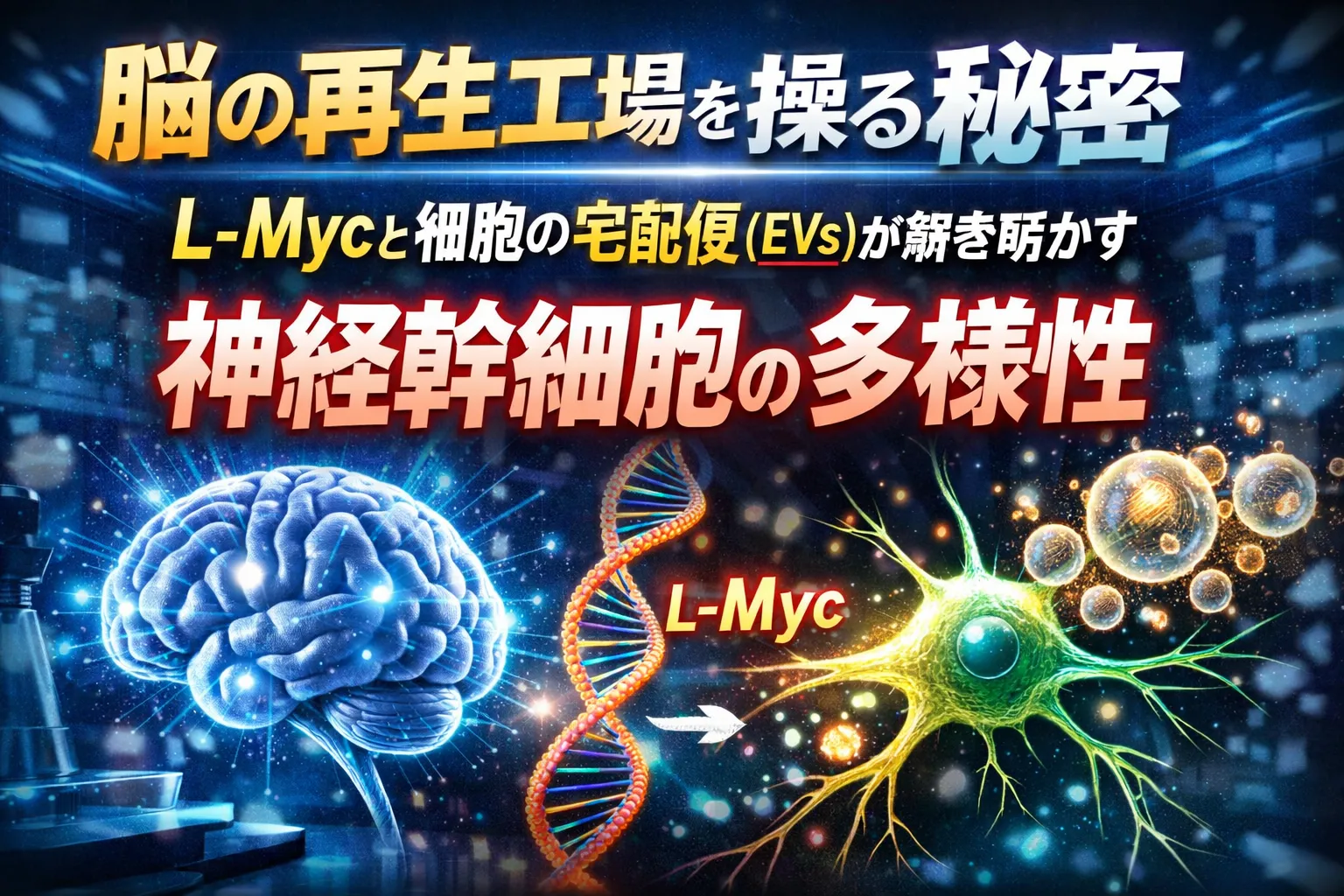
Table of Contents
- Introduction: Why this study matters
- The conventional wisdom: What we did not know
- The new discovery: What this study revealed
- A detailed look at the molecular mechanism
- Expectations for clinical application
- Summary
- Article information
1. Introduction: Why this study matters
The brain is an organ that is extraordinarily difficult to repair once it is damaged. Neurons lost to neurodegenerative diseases such as Alzheimer’s disease and Parkinson’s disease, or to stroke and traumatic brain injury (TBI), barely regenerate on their own. This “limit on the brain’s regenerative capacity” is one of the greatest challenges modern medicine faces.
Yet there is still a glimmer of hope within the brain: the “neural stem cells (NSCs).” NSCs are the brain’s “reserve corps,” and they have the ability to differentiate into new neurons and into the glial cells that support them when needed. They are like a team of artisans who run the brain’s regeneration factory.
This study tackles a fundamental question: how can we operate this regeneration factory as efficiently and as precisely as possible? It pays particular attention to “L-Myc,” a key gene that determines the abilities of NSCs, and to the “extracellular vesicles (EVs)” that carry out communication between cells.
If we could use this “master key” called L-Myc to find the population of NSCs that produce neurons most efficiently, and could further manipulate the “information capsules” they release—the EVs—then groundbreaking therapies could emerge for regenerative medicine after brain injury and for intractable neurological diseases. This study is a remarkably groundbreaking step that sketches out exactly that future vision of regenerative medicine.
2. The conventional wisdom: What we did not know
In earlier research, neural stem cells (NSCs) were often treated as a uniform population of cells, but in reality this was not the case. NSCs are like a group of employees with various skills working inside one large company. One employee is good at proliferating (self-renewal), another is good at making new products (neurons) (differentiation), and yet another may be dormant (the quiescent phase).
Overlooking the diversity in the “faces” of neural stem cells
Conventional analytical methods ground up thousands or tens of thousands of cells together and analyzed them as a batch. This is useful for looking at a company’s average overall performance, but it could not capture the individual abilities and activity of each cell—“which employee, when, is making what kind of custom-built product (a specific neuron).” In other words, there should be “elite artisans” within the NSC population with especially high neurogenic potential (neurogenesis), yet their existence could not be detected.
Cell-to-cell communication is like a “postal system”
The role of extracellular vesicles (EVs) was also unclear. EVs are tiny nanometer-sized capsules released by cells, packed with “messages” such as proteins and nucleic acids (RNA and the like). They can be compared to a “postal system” in cell-to-cell communication. Cells use this courier service of EVs to send specific instructions or information (commands such as “proliferate more” or “differentiate”) to cells far away.
In conventional research, however, it remained a black box which type of NSC packs which kind of “message (molecule)” into EVs and sends it off, and exactly what that message instructs. In particular, it was completely unknown what kind of special message is carried by NSCs in which the L-Myc gene is active.
To overcome these challenges, this study introduced a cutting-edge technique called “single-cell analysis,” which can track the activity of individual cells in detail. With it, the researchers sought to reveal the “diversity of faces” in the NSC population and, further, to identify the “custom-built messages” in the EVs released by those diverse cells.
3. The new discovery: What this study revealed
The greatest achievement of this study is that it proved, at the single-cell level, that the population of neural stem cells (NSCs) is more diverse than we had imagined and is made up of a “specialist population” devoted to specific abilities. The research team made the following important discoveries.
Discovery 1: Identification of an “elite progenitor cell” within the L-Myc-expressing NSC population
The research team analyzed in detail an NSC population in which the gene L-Myc had been activated. L-Myc is a transcription factor that acts like an “accelerator,” deeply involved in cell proliferation and the maintenance of an undifferentiated state. The analysis revealed that even among NSCs expressing L-Myc, there is a distinct “progenitor cell population” with especially high neurogenic capacity (the ability to produce new neurons). This population has a gene-expression pattern different from other cells, like a chosen team of artisans within the regeneration factory who specialize in making “custom, high-performance neurons.”
In conventional population-level cell analysis, the signal of this elite group was buried under the signals of vast numbers of other cells; but single-cell analysis brought their “faces” and “abilities” into relief for the first time.
Discovery 2: EVs are an “express courier” that transmits the L-Myc signal to distant sites
Next, the research team analyzed in detail the contents of the extracellular vesicles (EVs) released by this L-Myc-expressing NSC population. EVs are information capsules released by cells, and their contents reflect the state of the cell.
The analysis found that EVs derived from NSCs expressing L-Myc are rich in specific microRNAs (miRNA) and proteins that promote neural differentiation and proliferation. This means that cells in which the “master key” L-Myc is switched ON pack a powerful order document—“Make new neurons!”—into the “express courier” of EVs and send it off to neighboring cells and to cells at distant sites.
What is especially important is the finding that these EVs have the function of promoting the proliferation and differentiation of neural progenitor cells non-cellularly (without transplanting the cells themselves), via the L-Myc signaling pathway. In other words, it was suggested that the regenerative capacity of the brain could be boosted simply by using the information capsules called EVs, without going through the difficult procedure of cell transplantation.
Discovery 3: The L-Myc signaling pathway controls the balance between neural differentiation and proliferation
The study also delved into the mechanism by which activation of the L-Myc gene controls the balance between “self-renewal (proliferation)” and “differentiation (becoming neurons)” of NSCs. It was shown that L-Myc not only multiplies cells but also plays a role in inducing specific differentiation pathways. This suggests that L-Myc functions not merely as an accelerator but also as a “switch toggling between proliferation and differentiation.”
This discovery emphasizes that the diversity of neural progenitor cells is not mere chance but is strictly managed by specific master regulators such as L-Myc, and it provides an extremely important guide for devising strategies in regenerative medicine about which cell population to target, when, and how.
4. A detailed look at the molecular mechanism
The core of this study lies in the complex signaling pathway that begins with the gene L-Myc, and in the molecular composition of the EVs that carry it outside the cell. Here we explain the main molecules that appear, comparing them to their “roles.”
A. The master regulator: L-Myc
L-Myc is a gene that encodes a protein called a “transcription factor” present inside the cell nucleus. A transcription factor is like a “commander” that switches the cell’s genes ON and OFF. The Myc family in particular (c-Myc, N-Myc, L-Myc, and so on) is known for its role in powerfully promoting cell proliferation (growth and division). L-Myc can be compared to a “button that raises the operating rate of the regeneration factory,” maintaining the undifferentiated state of neural stem cells while encouraging their proliferation. This study showed that activating L-Myc gives rise to a progenitor cell population specialized for neurogenesis.
B. The cell-to-cell communication system: Extracellular Vesicles (EVs)
EVs are small sacs wrapped in a lipid bilayer secreted by cells. By size, they are classified into exosomes (30–150 nm), microvesicles, and others. These are the “courier capsules” between cells, transporting the state and commands of the cell.
Among the EVs derived from L-Myc-expressing NSCs, important “message molecules” that especially promote neural differentiation were packed inside. The representative example is the microRNA (miRNA).
C. The message molecule: microRNA (miRNA)
miRNA is a small RNA molecule that suppresses gene expression. It binds to the mRNA (messenger RNA) that serves as a gene’s blueprint and acts to “pause” the translation of that gene into protein. miRNA is like a “volume knob” that fine-tunes cellular activity.
The specific group of miRNAs contained in the EVs of L-Myc-expressing NSCs (the exact types depend on the paper, but miR-124 and miR-133, which are generally involved in neurogenesis, are considered important) suppresses, within the receiving cell, the activity of genes that inhibit neural differentiation (for example, genes that try to maintain proliferation) and amplifies the signal of “Now, it is time to become a neuron!”
D. The analytical method: single-cell RNA sequencing (scRNA-seq)
These discoveries were made possible by an innovative technique called single-cell RNA sequencing (scRNA-seq). Whereas conventional RNA sequencing measures the average gene expression of thousands of cells, scRNA-seq literally analyzes the gene-expression profile of “each individual cell.” This is like, rather than measuring the average height of a large crowd, recording in detail each person’s height, weight, occupation, and even hobbies. With this technique, the research team was able to clearly identify the “elite progenitor cells,” only a few percent of the total, hidden within the L-Myc-expressing NSC population.
E. The story of how the molecules interact
To summarize the story, it goes like this:
- A neural stem cell (NSC) in which L-Myc has been activated issues the command “Run the regeneration factory at full capacity!”
- Some of the NSCs that receive this L-Myc signal begin to differentiate into a progenitor cell population with especially high neurogenic capacity.
- These elite progenitor cells pack a “custom-built message” reflecting their own state into the courier capsules called EVs.
- Inside the EVs are miRNAs and the like that promote neural differentiation, and these are delivered to surrounding cells.
- Cells that receive the EVs, through the action of the miRNA, suppress their own proliferation and accelerate differentiation into neurons.
In this way, it was revealed that L-Myc not only acts directly inside the cell but also, using the non-cellular tool of EVs, spreads its regenerative capacity to distant sites and to other cells.
5. Expectations for clinical application
The insights this study brings hold the potential to fundamentally change the treatment of neurodegenerative diseases and brain injury.
Realizing targeted cell therapy
Until now, therapies that transplant NSCs have been attempted, but there were risks that the transplanted cells would not differentiate into neurons as intended and would instead form tumors or become non-functional cells. With this study, however, the “progenitor cell population with the highest neurogenic capacity” induced by the L-Myc signal has been identified.
The first step toward clinical application is to isolate and culture this elite cell population at high purity outside the body and to transplant it precisely into the damaged region of the brain. This is expected to dramatically increase the probability that the transplanted cells will be efficiently replaced by functional neurons.
A non-cellular treatment strategy using EVs
Even more groundbreaking is a treatment strategy that uses the EVs (information capsules) released by NSCs, rather than transplanting the cells themselves.
Because EVs are wrapped in cell membrane, they are stable within the body and can efficiently deliver specific message molecules to the damaged site. Compared with cell transplantation, they carry a lower risk of rejection, and their manufacture and storage are relatively easy.
For example, by purifying EVs derived from L-Myc-expressing NSCs and injecting them into the brain’s damaged region or administering them by drip infusion, it might become possible to boost the regenerative capacity of the patient’s own remaining neural stem cells. This is like sending only a “high-performance tool set” into the brain’s regeneration factory and drawing out the abilities of the artisans (the patient’s own cells).
The road to practical use and the challenges
Several steps are needed to achieve clinical application.
- Verification of safety and efficacy (preclinical studies): First, using animal models (mice and rats), it is necessary to thoroughly confirm whether the identified EVs actually contribute to the recovery of brain function and to check their long-term safety (in particular, whether there is a risk of tumor formation).
- Establishing the manufacturing process: A technique must be established to produce therapeutic-grade EVs in large quantities and uniformly.
- Clinical trials: After that, only through Phase I (safety), Phase II (efficacy), and Phase III (large-scale efficacy) clinical trials in humans does practical use finally come about.
This study is still at a basic stage, but elucidating the function of the L-Myc pathway and EVs brings new hope for patients after neurodegenerative diseases and traumatic brain injury to regain lost function.
6. Summary
This study made full use of cutting-edge single-cell analysis technology to approach the secret of the regenerative capacity of neural stem cells (NSCs). It clearly identified that within the NSC population, which had conventionally tended to be regarded as uniform, there exists an elite progenitor cell population with extremely high neurogenic capacity, induced by a specific gene, L-Myc.
Furthermore, it revealed that the extracellular vesicles (EVs) released by these cell populations carry molecules such as the miRNA that bears the L-Myc signal and function as an “express message” that promotes neural differentiation in surrounding cells.
This discovery opened the possibility of a non-cellular treatment strategy that uses the “information capsules” of EVs as a drug, going beyond the conventional framework of regenerative medicine that “transplants cells.” Understanding the mechanism of L-Myc and EVs will become the foundation for developing targeted, effective therapies for intractable neurological diseases such as Alzheimer’s disease and brain injury in the future.
7. Article information
Title (Japanese): L-Myc発現神経幹細胞とその細胞外小胞の単一細胞解析により明らかになった神経発生能を持つ明確な前駆細胞集団
Title (English): Single-Cell Analysis of L-Myc Expressing Neural Stem Cells and Their Extracellular Vesicles Revealed Distinct Progenitor Populations With Neurogenic Potential.
Authors: Pirrotte P, Yuan YC, Hansen NP, Vasquez I, Jiang N, Ojeda AV, Alsop E, Martinez MN, Sharma R, Hunsar M, Peton B, Palomares DM, Brewster B, Barish M, Bondi CO, Rockne RC, Jovanovic-Talisman T, Van Keuren-Jensen K, Kline AE, Gutova M.
Journal: J Extracell Biol (2025)
DOI: 10.1002/jex2.70095
Journal evaluation: J Extracell Biol is a specialist journal that publishes important findings in the field of extracellular biology, particularly extracellular vesicle (EV) research, and it carries high influence and reputation in this field.