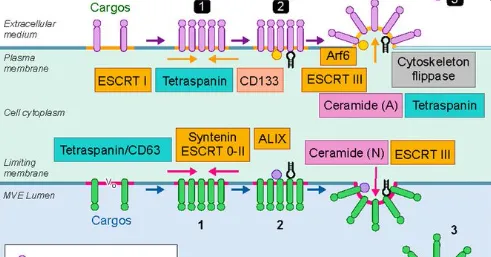
This article explains the ESCRT (endosomal sorting complexes required for transport) proteins involved in the release of extracellular vesicles (EVs).
The formation and release of exosomes/EVs depend on structures called endosomes that arise inside certain cells. Within the endosome, a specific group of proteins known as ESCRT proteins acts. ESCRT is important for controlling the processes of vesicle formation, the selective sorting of proteins, and vesicle release. ESCRT proteins therefore hold the key to intercellular communication and can have a major influence on the physiological and pathological states of cells.
These proteins perform the work needed to ensure that exosomes/EVs contain the appropriate components and to dispatch them accurately from the endosome to the extracellular space. This process is composed of a series of molecular steps, and different ESCRT complexes (ESCRT-0, I, II, III) are involved along the way.
- Selection of ubiquitinated proteins: As the endosome matures, ubiquitinated proteins carried in from various locations in the cell gather on the endosomal membrane. Ubiquitination refers to the biochemical process in which a small protein called ubiquitin attaches to a protein. Ubiquitin is a protein made up of 76 amino acids and is present in all eukaryotic cells. The ubiquitination process proceeds as follows: Activation: a ubiquitin-activating enzyme (E1) activates ubiquitin in the presence of ATP. Conjugation: a ubiquitin-conjugating enzyme (E2) receives the activated ubiquitin. Ligation: a ubiquitin ligase (E3) receives ubiquitin from E2 and attaches the ubiquitin to a specific target protein. Ubiquitinated proteins play an important role in the formation of intraluminal vesicles. Intraluminal Vesicles (ILVs) are small bubble-like structures that exist inside the endosome. They form inside the cellular structure known as the endosome.
- The role of ESCRT-0: Here, the ESCRT-0 complex acts. ESCRT-0 specifically binds ubiquitinated proteins and determines the location (domain) on the endosomal membrane where vesicle formation begins.
- Initiation of membrane curvature: Through the action of ESCRT-0, the presence of ubiquitinated proteins gathered in a specific domain causes the endosomal membrane to begin curving inward. This is the early stage of intraluminal vesicle formation.
- The action of ESCRT-I and ESCRT-II: Subsequently, the ESCRT-I and ESCRT-II complexes intervene, deepening the membrane curvature further and forming a “bud” in which the vesicle protrudes into the endosomal lumen. These complexes deform the membrane further and assist in vesicle formation.
- The ESCRT-III complex: Finally, ESCRT-III binds and supports the formation and scission of the complete vesicle. This complex bends and closes the membrane, and the vesicle is fully detached into the endosomal lumen.
Thus, ESCRT proteins are involved at every stage of the process of generating and releasing EVs from the endosome, enabling accurate communication and material transport within the cell. Such processes are extremely important for cell survival, growth, and differentiation, and when abnormalities occur they can give rise to disease.