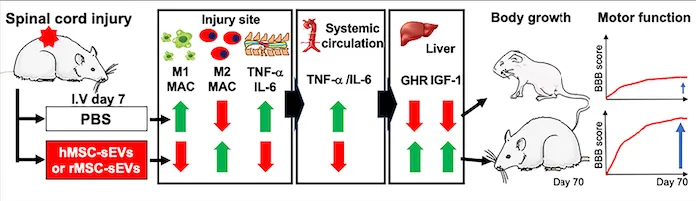
I am currently conducting research that verifies the therapeutic effects of extracellular vesicles (exosomes) derived from bone marrow mesenchymal stem cells, and in the future I aim for clinical application to various diseases. In a previous study, using a rat spinal cord injury model, we reported that exosomes account for much of the therapeutic mechanism of intravenous mesenchymal stem cell (MSC) therapy—in other words, that MSCs may deliver their therapeutic effects via exosomes.
However, that was a study of rat exosomes using rat MSCs. Rats and humans are of course not necessarily the same. The present study, with a view to the clinical application of exosome therapy, is a verification using human MSC exosomes. The target disease is “spinal cord injury.”
Verifying the therapeutic effect on improving paralysis was the initial aim, but as I continued my observations I noticed that body size clearly differed between the treatment group and the control group. In the clinical setting as well, patients with severe spinal cord injury (SCI) lose weight rapidly during the acute phase. It is of course also true that the loss of muscle mass due to paralysis has a large effect. However, if muscle mass declines too much, the effect of rehabilitation is diluted.
The phenomena confirmed in this human MSC exosome intravenous therapy were:
- Promotion of motor function recovery
- Immunomodulatory action at the injury site
- Suppression of circulating inflammatory cytokine levels throughout the body
- Suppression of the decrease in growth hormone receptors in the liver
- An increase in circulating Insulin-like growth factor-1 (IGF-1) throughout the body (a cytokine important in body growth)
and others. So let us now take a look at the actual content of the paper.
What is spinal cord injury?
Spinal cord injury occurs when the spinal cord is physically damaged. This is often caused by various accidents, such as traffic accidents, sports accidents, and falls. Spinal cord injury can cause the loss of sensory or motor abilities, and in severe cases it can cause quadriplegia (a state of losing all or part of the sensation and motor ability of the four limbs). At the current level of medicine, effective drugs and treatments to improve this paralysis are limited and their effects are insufficient, and many patients live with disabilities.
Spinal cord injury and body growth
In young adults, spinal cord injury causes not only severe sensorimotor impairment but also a delay in growth during the acute-to-subacute phase. Circulating inflammatory cytokines throughout the body are associated with growth failure and muscle wasting. However, recent studies have shown that small extracellular vesicles (sEVs) derived from human mesenchymal stem cells (MSCs) can have a therapeutic effect on body growth and motor recovery after severe spinal cord injury in young adult rats, and may modulate inflammatory cytokines.
What are mesenchymal stem cell-derived extracellular vesicles?
Mesenchymal stem cells (MSCs) are specialized cells that exist in various locations in the body, such as the bone marrow and adipose tissue. These cells have self-repair capacity and immunomodulatory capacity. The small extracellular vesicles (sEVs) secreted from MSCs help communication between cells and have the ability to modulate the inflammatory response. In particular, bone marrow mesenchymal stem cells are the most studied MSCs and are stem cells in which clinical research is also advancing.
Methods of the study
In this study, rats that had received a spinal cord injury were randomly divided into three different treatment groups (human and rat MSC-sEVs and a PBS group), and treatment was administered on day 7 after spinal cord injury. Motor function recovery and body growth were assessed weekly until day 70 after spinal cord injury. We also evaluated the movement of sEVs within the body, the uptake of sEVs within cells, the macrophage phenotype at the injury site, and cytokine levels at the injury site, in the liver, and circulating throughout the body.
Results of the study
The results of the study showed that intravenous administration of both human and rat MSC-sEVs improved the recovery of motor function after spinal cord injury and restored the normal body growth of young adult spinal cord injury rats.
The BBB score is out of a maximum of 21 points. 0 points means complete paralysis; 21 points means no paralysis. The exosome treatment group showed significantly better motor function recovery.
The spinal cord injury control rats are emaciated (B), whereas the exosome treatment groups (C; human exosomes, D rat exosome group) are not.
When human exosomes were administered intravenously, they were selectively taken up by macrophages/microglia in the lesion site.
In vitro experiments showed that, in a pH 6 environment, they were taken up only by activated M2 macrophages.
Furthermore, administration of human or rat MSC-sEVs increased the proportion of M2 macrophages and reduced the production of the pro-inflammatory cytokines tumor necrosis factor-α (TNF-α) and interleukin (IL)-6 at the injury site.
In addition, the levels of TNF-α and IL-6 in the serum circulating throughout the body decreased, and the production levels of growth hormone receptor and IGF-1 in the liver increased. Serum IGF-1 levels were also confirmed to be significantly elevated in the treatment group.
IGF-1 is the abbreviation for Insulin-like Growth Factor 1, a type of hormone produced within the human body. This hormone assists the action of growth hormone (GH) and plays an important role in the growth and development of the body.
IGF-1 promotes the growth of bone and muscle in particular. It also stimulates the growth and differentiation of cells and, by helping to generate new cells, contributes to the repair and regeneration of the body. Furthermore, IGF-1 is also involved in the regulation of blood glucose levels.
However, if IGF-1 levels are not appropriate, problems can arise in body growth and development. For example, if IGF-1 levels are low, growth may be delayed. Conversely, if IGF-1 levels are too high, they may cause excessive growth or other health problems.
Conclusion
The results of this study indicate that intravenous MSC-sEV therapy may contribute to the recovery of body growth after spinal cord injury in young adult rats by reducing systemic pro-inflammatory cytokines and increasing hepatic GHR and IGF-1. Human-derived MSC-sEVs, like rat-derived MSC-sEVs, had the effect of promoting both functional recovery and the normalization of body growth. This indicates that the interruption of growth after spinal cord injury in young rats may be alleviated by hMSC-sEV therapy. These results have important therapeutic implications for spinal cord injury patients, especially young spinal cord injury patients in whom the interruption of growth may be more problematic.