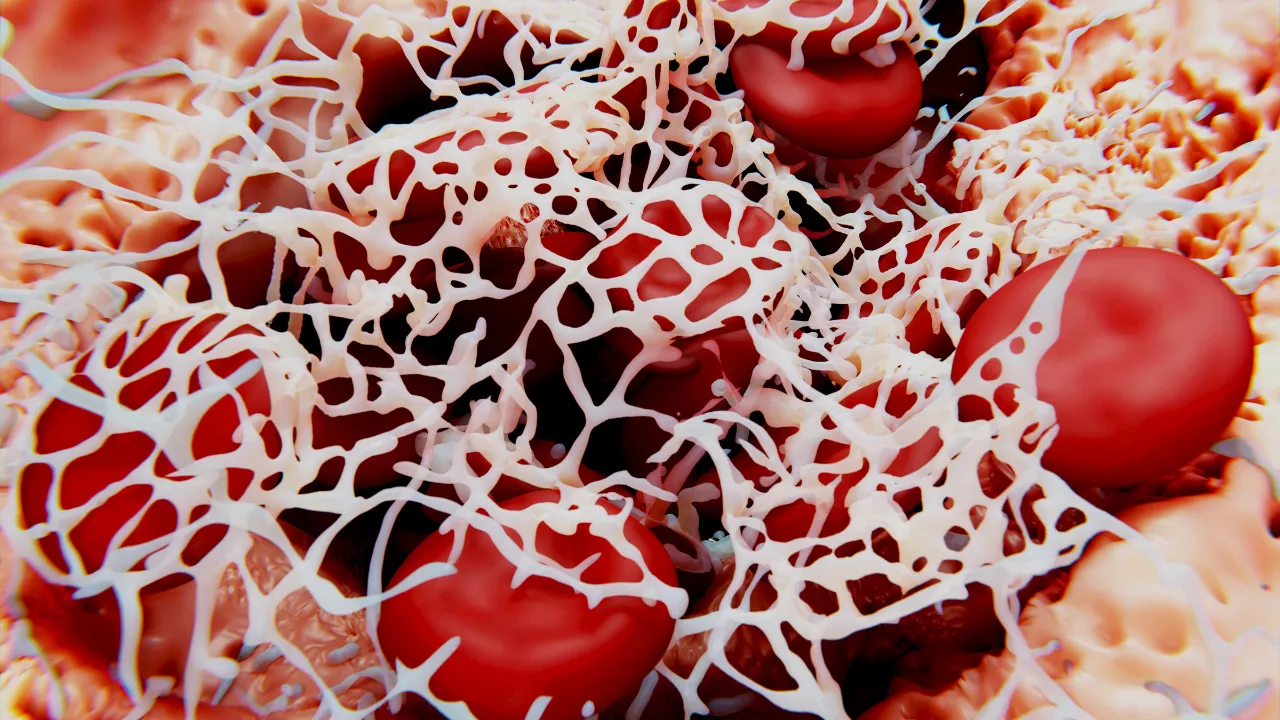
After spinal cord injury (SCI), scar tissue forms at the injury site. This tissue is composed of a glial component and a fibrin component. The glial scar is characterized by extensive proliferation of astrocytes surrounding the lesion core. The fibrin-like scar occupies the center of the lesion and is composed of fibroblasts and a dense extracellular matrix (ECM).
This scar tissue not only plays a protective role by limiting the spread of inflammation and secondary injury to the surrounding healthy tissue, but it also acts as an inhibitory barrier to axonal regeneration. While recent research on scar tissue has focused mainly on the glial scar, the fibrin component has received less attention. In vitro models of scar tissue using co-cultures of astrocytes and meningeal fibroblasts show that the fibrous scar forms a barrier to axonal growth. In vivo experiments removing fibroblasts have been shown to cause a loss of tissue integrity at the injury site and the formation of cavities. Therefore, understanding how the fibrous scar forms may provide new insights into the pathology of spinal cord injury. This time, we would like to examine Fibronectin, which is abundant in the fibrous scar.
Introduction
Fibronectin: How the body’s “glue” works
Our bodies are made up of more than several hundred types of cells. What lies behind these cells forming not just a “mass” but efficiently functioning tissues and organs? One answer to this is a protein called “fibronectin.”
Fibronectin plays many important roles in our bodies. Simply put, this protein acts like a “glue” that binds cells to one another, or cells to the surrounding “matrix.”
Why is this topic important?
In medicine, particularly in cancer research, wound healing, and immune responses, fibronectin is an extremely important component. When fibronectin’s function is insufficient, communication between cells is disrupted, which can become the cause of various diseases. Conversely, fibronectin’s function is driving the development of new therapies and diagnostic methods.
What can you learn from this article?
In this article, we explain what fibronectin is, how it works, and why it is important for our health. In particular, we focus on the multifunctionality this protein possesses and the effects it has on the human body.
What is fibronectin?
The basic definition of fibronectin
Fibronectin is a multifunctional, high-molecular-weight protein. This protein plays a role in helping cells “adhere” to one another and is important for maintaining the structure and function of tissues. The protein itself is composed of several parts called “domains,” each of which has a specific function.
Where it is found and its main functions
Where it is found
Fibronectin is present in various places in the body, but it performs particularly important functions in the following locations.
- In the blood: Known as plasma fibronectin, it is involved in clotting and repair at sites of injury.
- Extracellular matrix: This is a complex network that exists around cells, where fibronectin binds cells to other matrix components.
- Cell membrane: It is also present on the surface of cells, where it is involved in cell-to-cell adhesion and signal transduction.
Main functions
- Cell adhesion: Fibronectin creates the “foundation” that allows cells to be anchored in their precise positions.
- Tissue repair: When there is a wound or injury, fibronectin helps the growth of new cells and the reconstruction of tissue.
- Immune response: When pathogens invade, fibronectin also plays a role in guiding immune cells to the precise location.
The structure of fibronectin
Amino acid composition
Fibronectin is a large protein consisting of about 2,000 or more amino acid residues. This long amino acid chain forms specific structures, allowing it to perform diverse functions. The types and sequence of amino acids are finely tuned according to the functions and interactions that fibronectin carries out.
Domain structure
Fibronectin is divided into independent functional units called specific “domains.” These each have their own specific functions, such as cell adhesion, interactions with proteins, and binding with sugar chains. The main domains are as follows.
- Type I, II, and III domains: These are the most common domains, involved in cell adhesion and interactions with other proteins.
- Heparin-binding domain: This domain binds with heparin, a part of the extracellular matrix.
3D structure
The three-dimensional (3D) structure of fibronectin is extremely complex so as to accommodate its multifunctionality. Multiple domains move flexibly relative to one another and can change shape as needed. This “variability” gives fibronectin its multifunctionality.
- Fiber formation: Fibronectin molecules can form fibrous structures under certain conditions. This is important for the construction and repair of tissue.
- Intermolecular interactions: Through the ability of its domains to bind with other proteins and components, it carries out functions in many biological processes.
The roles of fibronectin
Our bodies are remarkably complex mechanisms, and many elements coordinate exquisitely so that everything functions smoothly. In this article, we focus particularly on the highly multifunctional protein “fibronectin” and explain its roles in detail.
Cell adhesion: the cells’ “social networking”
How do cells form tissues with one another? One answer is cell adhesion by fibronectin. Fibronectin is present on the outside of cells, binding cell to cell, or cells to the cellular “foundation” called the extracellular matrix (ECM).
Through this adhesion process, cells are anchored in their precise locations, forming various tissues such as muscle, skin, and internal organs. When this mechanism is disrupted, tissue formation becomes incomplete, which can become the cause of many diseases.
Tissue repair: the “repairer” that mends the injured body
When we are injured, how does the wound heal? Fibronectin plays a very important role in this process as well. This protein gathers at the injured area, promotes the growth of new cells, and repairs the wound.
In particular, fibronectin attracts cells called fibroblasts, which help form new cellular tissue. Through this process, scarring is minimized and faster recovery is promoted.
Immune response: the “defensive wall” against invaders
Fibronectin is also closely involved in the immune response. When an infection occurs, fibronectin guides immune cells to the site of infection. Specifically, when immune cells such as leukocytes and macrophages bind with fibronectin, these cells rapidly reach the site of infection and act to suppress the infection.
The fibrous scar usually contains a large amount of a substance called fibronectin. This substance is not normally found at high concentrations in the adult spinal cord, but it appears in large quantities after spinal cord injury. This is because it is produced from various places, such as specific active cells, immune cells, or fibroblasts at the injury site.
Fibronectin is known not only to function as a scaffold to which many other cell-supporting molecules can bind, but also to be involved in several important cellular activities such as migration, proliferation, and differentiation.
Macrophages and Fibronectin
Fibronectin and disease: from cancer to inflammation and tissue damage
Cancer: a promoter of metastasis?
In the progression of cancer, fibronectin is often highly expressed. Research has pointed out that these high fibronectin levels may promote “metastasis,” in which cancer cells spread to other tissues and organs.
Specifically, fibronectin is thought to enhance the ability of cancer cells to adhere to other cells and the extracellular matrix (ECM), which is said to aid metastasis. However, the full picture has not yet been completely elucidated, so future research is awaited.
Inflammation: a double-edged sword
Fibronectin is also closely involved in the inflammatory response. On the one hand, this protein plays a role in guiding leukocytes to the injured area, aiding the early healing process. However, excessive production of fibronectin may also prolong inflammation.
When inflammation becomes chronic, excessive accumulation of fibronectin can cause hardening and dysfunction of tissue. This can sometimes become a contributing factor to fibrosis.
Tissue damage: structural collapse
When fibronectin is insufficient, the adhesion between cells, or between cells and the ECM, weakens, which can cause the structure of tissue to break down. This can lead to dysfunction of organs such as the heart, liver, and lungs.
In particular, a deficiency of fibronectin can cause many health problems, such as delayed wound healing, weakened skin, or restricted joint movement.
Cutting-edge fibronectin research: applications to future medicine and unresolved questions
Because fibronectin is an important protein involved in many physiological and pathological processes, research into its mechanisms is being actively conducted. In this article, we explore ongoing research and its significance, as well as unresolved problems.
Ongoing research and its significance
Application to cancer treatment
Because the expression of fibronectin is associated with the progression of cancer, new therapies targeting this protein are being researched. For example, there is research that uses antibodies against specific domains of fibronectin to suppress the spread of cancer cells.
Inflammation control
When inflammation becomes chronic, excessive accumulation of fibronectin can become a problem. Regarding methods to control it, work is progressing on interactions with anti-inflammatory drugs and the discovery of new molecular targets.
Tissue engineering
Because fibronectin is important for cell adhesion and tissue formation, applications in tissue engineering are anticipated. In particular, understanding how fibronectin functions is important in the development of artificial organs and tissues.
Unresolved issues
Elucidation of detailed mechanisms
The functions and interactions of fibronectin are extremely complex, and their detailed mechanisms have not yet been completely elucidated.
Side effects and safety
Even if treatments targeting fibronectin are effective, data on their side effects and long-term safety are still insufficient.