Non-classical monocytes are supported by the entire vascular tree
Non-classical monocytes have the support of the whole vascular tree - Nature Reviews Immunology
Journal name and year of publication: Nature Reviews Immunology, 2024
First and last authors: First author: Thierry G.R.; last author: Baudon S.
First affiliation: Department of Immunology, [University Name]
Abstract:
Non-classical monocytes (NCMs) are circulating phagocytes that play roles resembling those of tissue-resident macrophages in immune surveillance, scavenging, and tissue repair. This study reveals that the entire vascular tree plays a crucial role in maintaining NCMs. In particular, it shows that vascular endothelial cells support survival by supplying the growth factor CSF1 to NCMs, and that Cx3cl1 regulates NCM access to CSF1.
Background:
Previous studies had shown that bone marrow endothelial cells supply CSF1 to support NCMs.
Methods:
The authors generated mice with constitutive or inducible deletion of Csf1 in endothelial cells and showed that, in these mice, NCMs in the bone marrow and blood were markedly reduced.
Results:
Endothelial CSF1 is required for the survival of NCMs, and deletion of Cx3cl1 from endothelial cells was shown to markedly reduce NCMs. Furthermore, it was suggested that NCMs deficient in Cx3cr1 take up CSF1 insufficiently.
Discussion:
The findings of this study suggest that the entire vascular tree functions as a niche for NCM survival and that access to CSF1 is determined by adhesive interactions.
Novelty compared with previous studies:
A new perspective was provided in which the entire vascular tree functions as an important niche for NCM survival.
Limitations:
This study is based on mouse models, and its applicability to humans requires further research.
Potential applications:
This study may contribute to the development of new therapeutic strategies to promote NCM survival.
What are non-classical monocytes (NCMs)?
Non-classical monocytes (NCMs) are a particular type of monocyte (a kind of white blood cell) present in the blood, and they play important roles in immune surveillance, removal (scavenging) of dead cells and foreign material, and tissue repair. NCMs have several properties that distinguish them from classical monocytes (CMs); in particular, they are often attached to the vascular endothelium, from which they receive growth factors and other signals to maintain their survival and function.
NCMs highly express a receptor called CX3CR1, which binds to a chemokine called CX3CL1 expressed by vascular endothelial cells. This interaction is important for NCMs to remain within the blood vessels, efficiently take up the growth factor called CSF1, and ensure their survival. As part of the body’s immune system, NCMs respond rapidly when abnormalities or injuries occur and play a role in promoting repair.
Under what circumstances are they activated?
Non-classical monocytes (NCMs) are activated mainly in the following situations.
- Vascular injury or inflammation:
When blood vessels are damaged or inflammation occurs in tissue, NCMs gather at that site and respond rapidly. When the chemokine CX3CL1 is expressed by vascular endothelial cells, NCMs attach to that site via the CX3CR1 receptor and promote the immune response at the site of inflammation. - Immune surveillance:
NCMs patrol the inside of blood vessels and detect abnormal cells and pathogens. This surveillance activity is an important function for quickly recognizing and dealing with abnormalities such as infection or tumor formation in the body before they develop. - Tissue repair:
NCMs are also involved in the repair process of damaged tissue. When damage occurs, NCMs gather at that site, remove dead cells and unnecessary tissue, and support the regeneration of new tissue.
In these situations, NCMs work actively and play an important role in helping the immune response and tissue repair.
Do NCMs transform into macrophages?
Non-classical monocytes (NCMs) are generally considered not to transform directly into macrophages. NCMs have their own roles and are mainly involved in immune surveillance and tissue repair. They differ from macrophages in the following respects.
- Roles and functions:
NCMs specialize in immune surveillance within the circulating blood and in repair inside blood vessels. Macrophages, on the other hand, reside in tissues and play central roles in removing foreign material, regulating immune responses, and maintaining tissue homeostasis. - Patterns of transformation:
Classical monocytes (CMs) are known to differentiate into macrophages and dendritic cells in response to various stimuli after migrating into tissues. However, NCMs mainly exert their function within blood vessels and are considered not to differentiate directly into macrophages. - The role of CSF1:
CSF1 (colony-stimulating factor 1) is an important factor that supports the survival of NCMs, but it does not provide a direct signal for NCMs to transform into macrophages. Rather, NCMs require CSF1 in order to continue carrying out their functions on the spot.
Therefore, NCMs usually do not transform into macrophages and are recognized as a distinct cell population with their own functions.
What is their relationship to macrophages?
The relationship between non-classical monocytes (NCMs) and macrophages is interesting in that NCMs are an independent cell population that, while having functions resembling those of macrophages, plays a different role. Specifically, NCMs perform macrophage-like functions—immune surveillance, removal of foreign material, and tissue repair—within blood vessels, but unlike macrophages, they usually do not migrate outside the blood vessels and differentiate into macrophages.
Details of the relationship:
- Functional similarity:
Like macrophages, NCMs are involved in the repair of tissue damage and in immune surveillance. However, these activities are carried out mainly within blood vessels. - Developmental origin and differentiation:
Macrophages differentiate from classical monocytes (CMs), reside in tissues, and function over long periods. NCMs, by contrast, remain within blood vessels and are considered to seldom differentiate directly into macrophages. - Sharing of the survival niche:
NCMs and macrophages both use the growth factor CSF1 to maintain their survival, but for NCMs it is important that this CSF1 is supplied by vascular endothelial cells. For macrophages, it is often supplied from other niches within the tissue.
This paper shows that NCMs maintain their survival through the uptake of CSF1 within blood vessels and play a distinct role different from that of macrophages. It also emphasizes that NCMs efficiently use CSF1 via adhesion mediated by CX3CL1 and thereby secure their survival within blood vessels. This indicates that, while functionally related to macrophages, NCMs survive in a different niche and carry out different functions.
Do NCMs phagocytose?
Yes, non-classical monocytes (NCMs) have phagocytic capacity. While circulating in the blood, NCMs recognize and phagocytose abnormal cells, foreign material, the debris of damaged cells, and so on. This phagocytic activity shows that NCMs perform an important function as part of immune surveillance and tissue repair.
Like tissue-resident macrophages, NCMs can take up and digest foreign material and pathogens, but their phagocytic activity is carried out mainly within blood vessels. For this reason, NCMs “patrol” the blood vessels and, by rapidly phagocytosing when an abnormality is found, contribute to maintaining tissue homeostasis.
This paper shows that NCMs perform phagocytosis as part of their surveillance activity within blood vessels. In particular, it emphasizes that NCMs have the ability to remove foreign material and damaged cells and work as part of the immune system.
What is the lifespan of NCMs?
The lifespan of non-classical monocytes (NCMs) is said to be from several days to several weeks. This period depends on the activities through which NCMs fulfill roles such as immune surveillance and tissue repair within blood vessels.
The lifespan of NCMs is controlled mainly by signals from the environment and by growth factors. In particular, a growth factor called CSF1 (colony-stimulating factor 1) plays an important role in NCM survival. This CSF1 is supplied by vascular endothelial cells, and by receiving this growth factor, NCMs can have their lifespan extended and maintain their function.
Furthermore, the interaction between the chemokine CX3CL1 and its receptor CX3CR1 is also involved in the lifespan of NCMs. When these signals are insufficient, the survival of NCMs becomes difficult, and as a result their lifespan has been reported to shorten.
This paper describes in detail the effects of CSF1 and CX3CL1 on NCM survival and shows that these signals play an important role in the lifespan of NCMs.
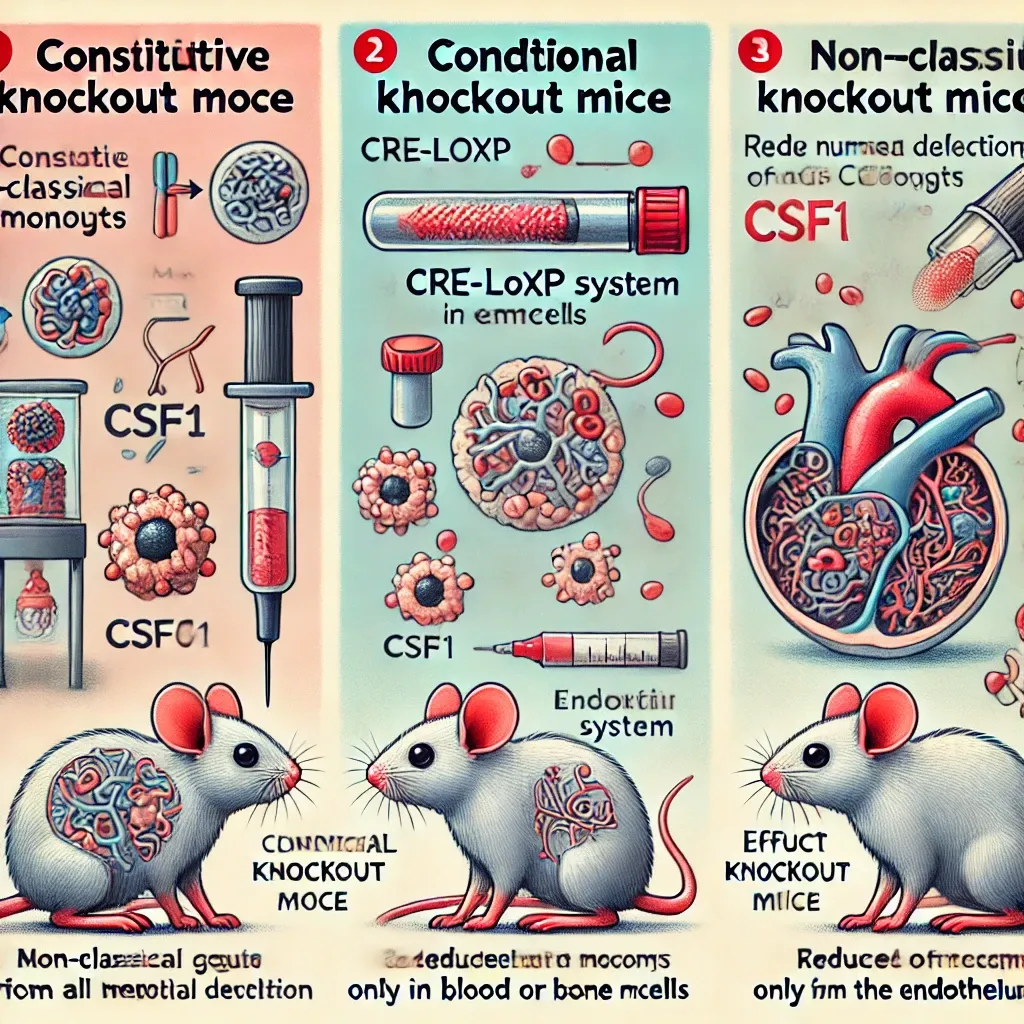
How are the mice knocked out?
Regarding the methods of knocking out mice in research related to non-classical monocytes (NCMs), the following gene knockout techniques are used.
- Gene knockout models:
Researchers delete (knock out) a specific gene (e.g., Csf1 or Cx3cl1) from the mouse genome to investigate what physiological role that gene plays. This allows them to observe the effect of the deletion of the target gene on the survival and function of NCMs. - Constitutive knockout mice:
In these mice, a specific gene is deleted at an early stage of embryonic development, so that the target gene is missing from all somatic cells. For example, in mice with a constitutive knockout of Csf1, NCMs in the blood and bone marrow have been observed to be markedly reduced. - Conditional knockout mice:
In a conditional knockout, a gene can be deleted only in a specific tissue or cell type, or only at a specific time. To achieve this, techniques such as the Cre-LoxP system are used. For example, by knocking out Csf1 only in endothelial cells, one can confirm whether NCMs depend on CSF1 supplied by the vascular endothelium. - Inducible knockout mice:
In this method, researchers can knock out a gene at a specific time. For example, by administering a specific drug (such as tamoxifen), the gene is temporally controlled and knocked out. This makes it possible to study the effect of a specific gene on the function of NCMs after the mouse has reached adulthood.
In this paper, constitutive and conditional knockout mice are used in order to clarify the importance of the Csf1 and Cx3cl1 genes for the survival of NCMs by knocking out these genes.