Table of Contents
- Introduction: Why this research matters
- The conventional wisdom: What was not understood
- The new discovery: What this study revealed
- A detailed look at the molecular mechanism: The savior of calcium and mitochondria
- Expectations for clinical application: The dawn of cell-free therapy
- Summary
- Paper information
1. Introduction: Why this research matters
Our brain enables complex activities such as thinking, memory, and movement through the coordinated work of an enormous number of nerve cells (neurons). However, in neurodegenerative diseases such as stroke, Alzheimer’s disease, and Parkinson’s disease, these precious neurons die off one after another. Particularly in the immediate aftermath of stroke or traumatic brain injury, a phenomenon called “excitotoxicity” is a major cause of cell death.
Excitotoxicity refers to a state in which the neurotransmitter glutamate is released in excess, causing neurons to literally “become overexcited and die from overwork.” It is much like turning a radio’s volume up to maximum and breaking the speaker. This uncontrollable excitation occurs in a chain reaction around the injured region of the brain and severely hinders recovery.
At present, treatments for these diseases are limited, and in particular the “neuroprotection” strategy of shielding neurons from death and restoring their function has been a long-standing challenge. Conventional therapies have faced limitations such as drugs not easily crossing the brain’s barrier (the blood-brain barrier) or causing significant side effects.
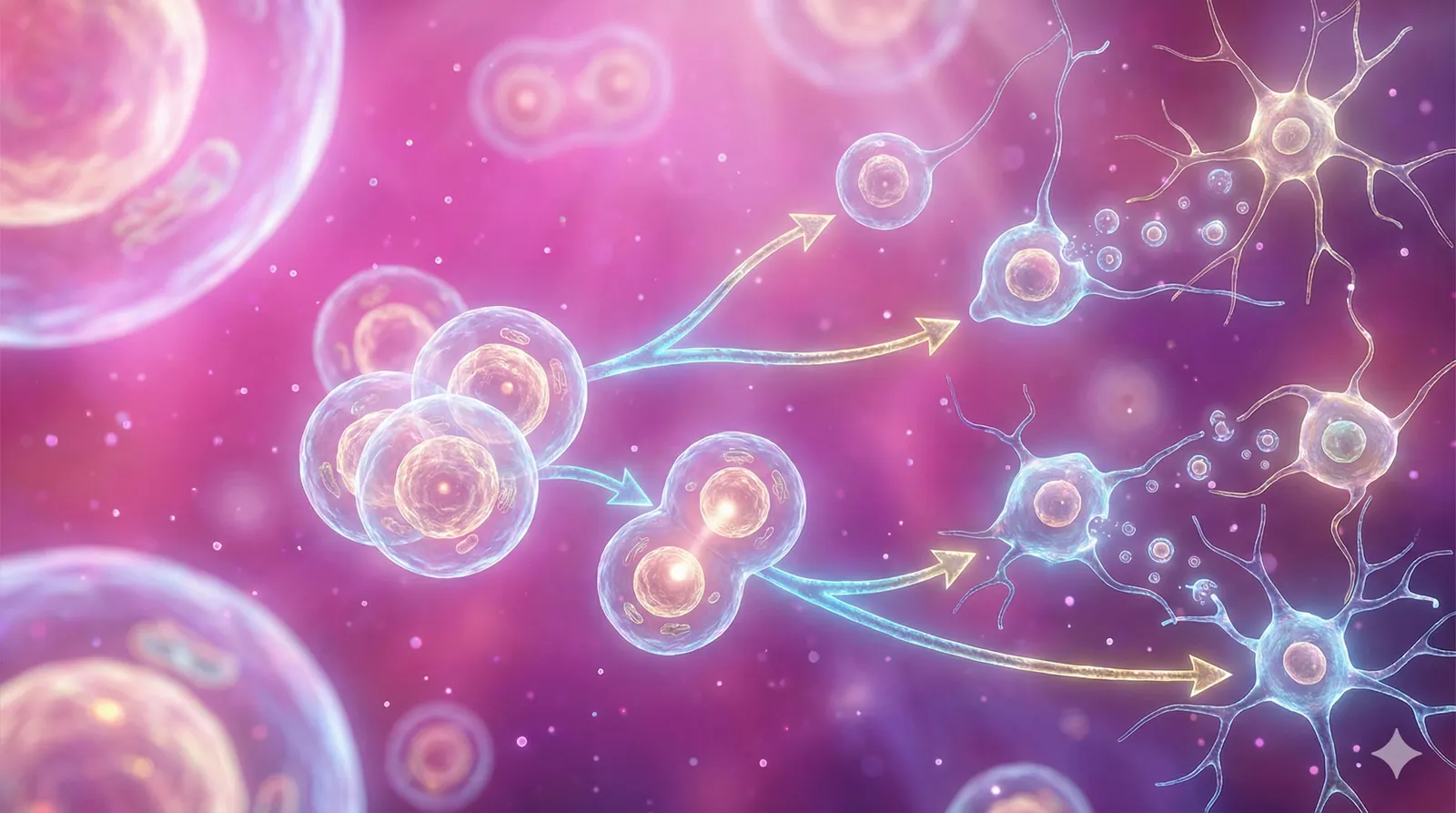
This study proposes an entirely new approach to this difficult problem. It involves using “extracellular vesicles (EVs)” secreted by “iPSC-derived glial progenitor cells (GPCs).” iPSCs (induced pluripotent stem cells) are versatile cells created from cells such as skin, capable of proliferating indefinitely and differentiating into a variety of cell types. The researchers elucidated, at the molecular level, that the tiny capsules (EVs) released by these baby glial cells (GPCs) made from iPSCs possess a remarkable ability to prevent the overwork death of neurons. This discovery can be called a groundbreaking step that opens the door to “cell-free therapy”—an effective future treatment with few side effects—for neurodegenerative diseases and brain injury.
2. The conventional wisdom: What was not understood
The mechanism by which neuronal excitotoxicity causes cell death has itself been studied for many years. The key is “calcium ions (Ca2+).” For neurons, Ca2+ plays a role like a switch for signal transmission. Normally, when glutamate binds to receptors on the cell surface (e.g., NMDA receptors), Ca2+ flows into the cell and a signal is transmitted.
However, when glutamate becomes excessive due to brain injury or the like, this influx of Ca2+ no longer stops. It is just like a broken water faucet stuck wide open, with water overflowing throughout the house. The Ca2+ that accumulates excessively inside the cell causes various intracellular enzymes to run amok and inflicts serious damage on the cell’s energy factory, the “mitochondria.”
Mitochondria are the cell’s power plant, and their function is maintained by the membrane potential (the electrical difference across the membrane). Excessive Ca2+ places a burden on the mitochondria and causes this membrane potential to collapse (mitochondrial depolarization). When the power plant stops, the cell can no longer produce energy (ATP) and ultimately heads toward apoptosis (programmed cell death).
Previous research had established that stem cell transplantation and glial cell transplantation have neuroprotective effects, but it was unclear why they were effective or what the “messenger” was. Communication between cells is much like a postal system. However, it was not previously understood which piece of mail (molecule) was carrying which message. Methods that transplant living cells carry risks of rejection and tumor formation, so there was a major barrier to their practical use as a treatment.
This is why researchers focused on the small capsules secreted by cells, extracellular vesicles (EVs). EVs load up proteins and nucleic acids (such as RNA) from inside the cell and deliver information to distant cells, like a “nanosized courier service.” If a “miracle drug” that prevents the overwork death of neurons were inside this courier package, then instead of transplanting living cells, administering these EVs alone should make safe and effective treatment possible. However, exactly how the EVs released by iPSC-derived glial cells prevent excitotoxicity—the molecular mechanism—remained shrouded in mystery.
3. The new discovery: What this study revealed
To unravel this mystery, the research team of Shedenkova et al. analyzed in detail the extracellular vesicles (EVs) secreted by glial progenitor cells (GPCs) differentiated from iPSCs, and verified their effects using a glutamate-induced excitotoxicity model (cultured neurons). Their main findings were the following three points.
Finding 1: EVs dramatically prevent glutamate-induced cell death
In the study, a lethal dose of glutamate was administered to cultured neurons to induce excitotoxicity. Normally, under these conditions, many cells die. However, in the cell group that had been treated with GPC-derived EVs in advance, cell survival improved markedly. This shows that EVs have an effect like putting “protective clothing” on neurons. This result clearly demonstrated that EVs are not mere cellular waste but powerful neuroprotective factors.
Finding 2: Stabilizing the abnormal “oscillation” of Ca2+
The core of excitotoxicity is the uncontrollable influx and abnormal oscillation of intracellular Ca2+. This is the aforementioned state of “the water faucet stuck wide open.” The research team measured the intracellular Ca2+ concentration in real time using fluorescent probes. In cells administered glutamate, the Ca2+ concentration rose sharply and continued to oscillate as large, unstable waves.
However, in cells pretreated with EVs, although the influx of Ca2+ occurred, its concentration was kept at an appropriate level and the abnormal oscillation was suppressed. The EVs functioned like a “flow-control device” that adjusts the broken faucet and stabilizes the water flow. This suggests that the EVs are “rebooting” the neuron’s signal transmission system into a normal state.
Finding 3: Preventing mitochondrial depolarization and maintaining energy production
Abnormal Ca2+ ultimately causes mitochondrial dysfunction. When the mitochondrial membrane potential collapses (depolarization), the cell loses energy and dies. The research team verified the effect of EVs using a dye that measures mitochondrial membrane potential (e.g., JC-1).
In glutamate-treated cells, the mitochondrial membrane potential was rapidly lost, but in cells treated with EVs, this depolarization was strongly suppressed. The EVs functioned as an “emergency backup system” that prevents the power plant (mitochondria) from shutting down due to overload and maintains a stable power supply. As a result, the neurons were able to escape death due to energy shortage.
These findings prompt a paradigm shift in neuroprotection strategy, from the conventional “cell transplantation” approach to a safer and more efficient “cell-free therapy” using “therapeutic factors secreted by cells (EVs).“
4. A detailed look at the molecular mechanism: The savior of calcium and mitochondria
The most important point of this study is that it revealed the molecular-level “blueprint” of how EVs achieve Ca2+ stabilization and mitochondrial protection. EVs are not merely lipid capsules but a treasure trove of various proteins and nucleic acids that GPCs selectively load in order to help neurons.
The “prime culprit” of excitotoxicity: glutamate receptors
What triggers excitotoxicity are the NMDA receptors (N-methyl-D-aspartate receptors) and AMPA receptors (α-amino-3-hydroxy-5-methyl-4-isoxazolepropionic acid receptors) on the surface of neurons. These are “ion channels” opened by glutamate, and when they open they allow Ca2+ and sodium ions (Na+) to flow into the cell from outside. When glutamate is excessive, these channels stay open, and Ca2+ floods in like a deluge.
The “calming kit” carried by EVs
What molecules the EVs carry requires detailed future analysis, but the mechanism suggested by this study is that EVs strengthen the system by which cells process intracellular Ca2+.
1. Stabilization of proteins involved in Ca2+ homeostasis
It is thought that specific proteins and microRNAs (miRNAs) contained in EVs, after being taken up by neurons, help the pumps and exchange transporters that regulate the intracellular concentration of Ca2+.
For example, the activity of pumps such as NCX (the Na+/Ca2+ exchange transporter), which expels Ca2+ out of the cell, and the SERCA pump, which stores Ca2+ in the endoplasmic reticulum (ER), an intracellular organelle, may be maintained by EVs. These pumps are like the cell’s “drainage system,” and EVs function as repair technicians for the drainage system’s pumps.
2. Stabilization of mitochondria
Maintaining the mitochondrial membrane potential involves complex protein complexes called the electron transport chain. The Ca2+ influx caused by excess glutamate inhibits this electron transport chain and ultimately opens a “hole” called the MPTP (mitochondrial permeability transition pore). When this hole opens, substances inside the mitochondria leak out, the membrane potential collapses, and cell death becomes irreversible.
EVs are thought to supply molecules that prevent the formation of this MPTP or that maintain mitochondrial function. Specifically, they may regulate the expression or activity of antioxidant enzymes or of proteins that control mitochondrial fission and fusion (e.g., Drp1, Mfn2). EVs are a “team of specialist technicians” that prevents holes from opening in the power plant’s walls and promotes stable operation.
Experimental method: How they made the discovery
The research team differentiated glial progenitor cells (GPCs) from iPSCs and purified EVs from their culture supernatant using ultracentrifugation and ultrafiltration. The purified EVs were confirmed for size (generally about 30 nm to 150 nm) and concentration by nanoparticle tracking analysis (NTA).
Next, before administering glutamate to the cultured neurons, they added EVs and observed the intracellular dynamics using fluorescence imaging techniques. The movement of Ca2+ was visualized using Ca2+-sensitive fluorescent dyes such as Fura-2, and its oscillation patterns were quantitatively analyzed. The mitochondrial membrane potential was also measured using fluorescent probes such as JC-1 and TMRE, demonstrating that EVs contribute to mitochondrial stability.
Through these detailed molecular imaging and biochemical analyses, it became clear that EVs not only reduce cell death but also directly repair its root causes—the Ca2+ abnormality and mitochondrial dysfunction.
5. Expectations for clinical application: The dawn of cell-free therapy
The greatest clinical significance of this study lies in the fact that it strongly demonstrated the potential of a new treatment strategy called “cell-free therapy.” Cell-free therapy is a treatment method that uses not the living cells themselves but the substances with therapeutic effects secreted by cells (in this case, EVs).
Advantage 1: Safety and low immunogenicity
When living stem cells are transplanted, there are always concerns about rejection and the risk of cells proliferating uncontrollably (tumor formation). However, because EVs do not have a cell nucleus, these risks are extremely low. EVs are easily broken down in the body and disappear quickly once they have served their role. They are like “disposable nanomessengers” that deliver only the necessary message and then vanish.
Advantage 2: Crossing the blood-brain barrier
Because EVs are very small and wrapped in a lipid bilayer, they are known to have properties that make them likely to cross the blood-brain barrier (BBB), which drugs normally cannot pass through. This is highly advantageous in treating the brain. Simply injecting EVs intravenously may make it possible to deliver neuroprotective molecules directly to the injured region of the brain.
Anticipated fields of application
- Acute-phase stroke treatment: In ischemia-reperfusion injury after cerebral infarction (damage that occurs after blood flow resumes), excitotoxicity becomes a serious problem. By administering EVs early, it may be possible to prevent the chain-reaction death of neurons and reduce aftereffects.
- Neurodegenerative diseases: Even in chronic diseases such as Alzheimer’s disease and Parkinson’s disease, mild excitotoxicity and mitochondrial dysfunction are involved as the pathology progresses. By administering EVs regularly, they are expected to play a role as “neurotrophic factors” that extend the lifespan of neurons and slow the progression of disease.
- Traumatic brain injury (TBI): Excitotoxicity also occurs after an impact to the brain from an accident or sports. EVs may be developed as an emergency therapeutic agent to prevent secondary injury after TBI.
Challenges to practical use
Several steps are still needed for practical use. First, the establishment of technology to produce EVs in large quantities and uniformly is required. It is necessary to manufacture high-quality EVs stably from iPSC-derived GPCs at the GMP (Good Manufacturing Practice) level. Next, large-scale animal experiments are needed to determine the dosage, route of administration, and optimal timing of treatment for EVs. And finally, the process moves to clinical trials that confirm safety and efficacy in humans.
However, the clear molecular mechanism shown by this study indicates that this “cell-free therapy” is not a mere pipe dream but a realistic treatment strategy backed by science.
6. Summary
Conventional wisdom held that neuronal death after brain injury is caused by an uncontrollable influx of Ca2+ due to excess glutamate and the subsequent shutdown of mitochondrial function. Treatments that transplant living cells were expected to be effective, but they had challenges in safety and practicality.
This study revealed that extracellular vesicles (EVs) secreted by iPSC-derived glial progenitor cells (GPCs) have a powerful protective effect against glutamate-induced excitotoxicity. After being taken up by neurons, EVs suppress the abnormal oscillation of intracellular Ca2+ and prevent the depolarization of the mitochondrial membrane potential caused by excess Ca2+, thereby maintaining the cell’s energy production and allowing it to avoid cell death.
This discovery holds the potential to accelerate the development of a new treatment method—“cell-free therapy”—that is safe, efficient, and acts across the blood-brain barrier, with EVs functioning as a “nanosized courier service” that carries neuroprotective molecules to treat stroke and neurodegenerative diseases.
7. Paper information
Paper title (Japanese):
iPSC由来グリア前駆細胞からの細胞外小胞は、カルシウム振動とミトコンドリア脱分極を安定化させることにより、グルタミン酸誘発性の興奮毒性を予防する
Paper title (English):
Extracellular Vesicles from iPSC-Derived Glial Progenitor Cells Prevent Glutamate-Induced Excitotoxicity by Stabilising Calcium Oscillations and Mitochondrial Depolarisation.
Authors:
Shedenkova M, Gurianova A, Krasilnikova I, Sudina A, Karpulevich E, Maksimov Y, Samburova M, Guguchkin E, Nefedova Z, Babenko V, Frolov D, Savostyanov K, Fatkhudinov T, Goldshtein D, Bakaeva Z, Salikhova D.
Journal:
Cells
Publication information:
Cells (2025), 14(23), 1915
DOI:
https://doi.org/10.3390/cells14231915
Journal assessment:
Cells is an open-access journal published by MDPI and is highly regarded in the field of cell biology. (Its impact factor as of 2023 is about 6.0.)