Overview
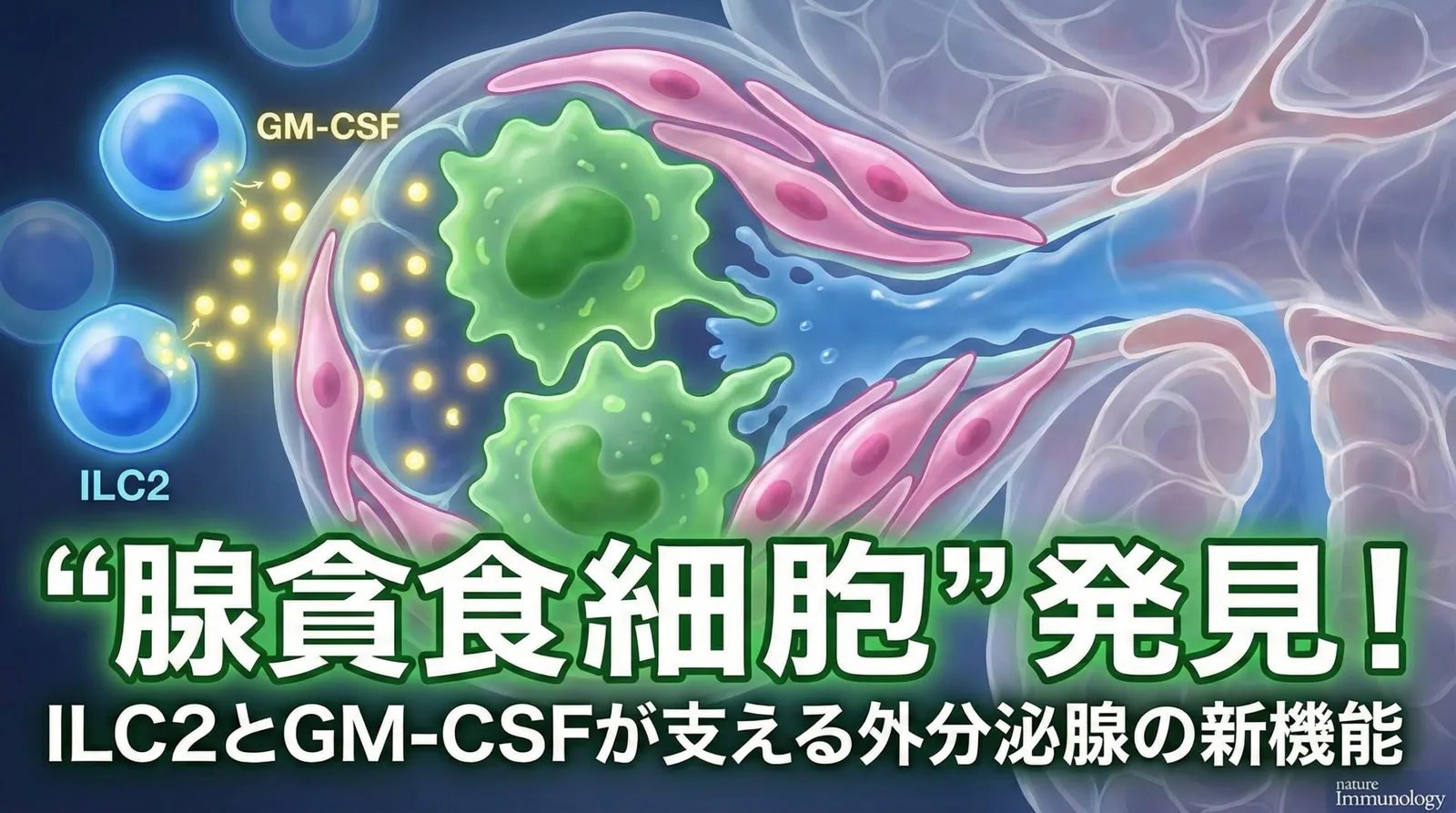
This landmark study revealed that exocrine glands, including the salivary glands, harbor a previously unknown specialized macrophage population termed “adenophages.” These cells are maintained by granulocyte-macrophage colony-stimulating factor (GM-CSF) produced by group 2 innate lymphoid cells (ILC2s) and play an essential role in the efficient secretion of saliva. Furthermore, this cell population also exists in humans, suggesting that it plays an important, cross-species role in maintaining the function of exocrine glands.
Journal: Nature immunology
Link: PubMed Link
Impact Factor: ~50.1
Journal Description: Nature Immunology is one of the most authoritative scientific journals in the field of immunology, reporting groundbreaking discoveries ranging from the fundamental mechanisms of the immune system to its roles in disease.
Background of the Study
Granulocyte-macrophage colony-stimulating factor (GM-CSF, Csf2) is widely recognized as a potent pro-inflammatory cytokine. However, it has long been known to play an essential role in the differentiation and maintenance of alveolar macrophages for the homeostasis of the organism. Despite this duality, it had remained unclear whether the development of macrophages in non-pulmonary tissues other than the lung similarly depends on GM-CSF. Closing this knowledge gap is an important motivation behind this study.
Key Findings (Explanation at the Molecular Level)
By performing a detailed analysis of developing tissues using GM-CSF fate-mapping mice and reporter mice, this study derived the following major findings.
- GM-CSF production by ILC2s: The researchers identified that group 2 innate lymphoid cells (ILC2s) present in the salivary glands produce GM-CSF. This suggests that ILC2s supply GM-CSF as a signaling molecule that regulates macrophage dynamics within a specific tissue microenvironment.
- Identification of “adenophages”: They discovered a previously unknown novel macrophage population maintained by ILC2-derived GM-CSF and named it “adenophages.” These cells are characterized as “atypical macrophages” with specific morphological and functional properties that differ from conventional GM-CSF-dependent macrophages.
- Development and dynamics of adenophages: Adenophages were shown to originate from fetal monocytes. However, after birth or during growth, these fetal-derived adenophages were shown to be gradually replaced by monocytes derived from monocyte-dendritic cell progenitors. This means that the macrophage population in exocrine glands undergoes a dynamic process in which it is composed of cells of different origins depending on the developmental stage.
- Formation and function of the spatial niche: It was found that adenophages form a specific spatial microenvironment (niche) together with the GM-CSF-producing ILC2s and the myoepithelial cells responsible for the secretory function of the gland. This close interaction among the three was shown to be essential for the efficient secretion of saliva. At the molecular level, the GM-CSF released by ILC2s is thought to promote the differentiation, survival, and expression of specific functions of adenophages, whereby adenophages coordinate with myoepithelial cells to regulate the release of saliva.
- Universality and conservation: Importantly, adenophages were confirmed to be present not only in the salivary glands but throughout other exocrine glands, including the lacrimal and mammary glands. Furthermore, these cells were shown to be present in human exocrine glands as well, strongly suggesting that the function of these adenophages has a conserved role in maintaining the homeostasis of exocrine glands across species.
Discussion from an Expert Perspective (Implications for MSC/EV/Aging)
This study clearly demonstrated the diversity of macrophages within specific tissue microenvironments and how deeply they are involved in tissue function. This discovery brings new perspectives to the fields of mesenchymal stem cells (MSC), extracellular vesicles (EVs/exosomes), and anti-aging research.
- Relation to MSC-derived EVs: This study showed that GM-CSF produced by ILC2s is essential for the differentiation and maintenance of specific tissue-resident macrophages (adenophages). MSCs are attracting attention for their immunomodulatory function and tissue regenerative capacity, much of which is exerted through the EVs that MSCs release. These findings raise the possibility that MSC-derived EVs could regulate the GM-CSF-producing capacity of ILC2s, or directly support the function or survival of adenophages. For example, when the function of an exocrine gland is impaired, a new approach to improve tissue function could be conceived in which MSC-EVs optimize the niche of adenophages and promote their interaction with ILC2s. The diverse bioactive factors carried by MSC-EVs may contribute to the development of therapeutic strategies targeting this GM-CSF–ILC2–adenophage axis.
- Polarization/regulation of macrophages: The identification of adenophages as “atypical” macrophages is a striking example of how a tissue-specific microenvironment deeply defines the diversity and functional phenotype of macrophages. The fact that GM-CSF is essential for their differentiation and maintenance reaffirms the important role that GM-CSF signaling plays in regulating macrophage function. The discovery of adenophages provides a new target for deeply understanding the mechanisms of macrophage polarization and functional regulation in exocrine glands. This knowledge may elucidate how abnormalities in adenophages contribute to the pathology of autoimmune exocrine gland diseases such as Sjögren’s syndrome, potentially leading to the development of therapies targeting macrophages with specific phenotypes.
- Application to anti-aging mechanisms: Decline in exocrine gland function, such as dry mouth and dry eye, is a common age-related problem that greatly affects quality of life. Because this study showed that adenophages are essential for saliva secretion, it strongly suggests that dysfunction of this cell population or a decrease in the supply of GM-CSF from ILC2s may be one cause of the age-related decline in exocrine gland function. Therefore, maintaining the activity of ILC2s and securing the supply of GM-CSF, or maintaining and restoring a healthy population of adenophages, could become a new anti-aging strategy against age-related exocrine gland dysfunction. By targeting this axis, the possibility of promoting “rejuvenation” of exocrine glands and alleviating related aging symptoms may be opened up.
Future Prospects
The results of this study have the potential to greatly influence the biology of exocrine glands, immunology, and clinical medicine. As future prospects, several innovative research directions and applications can be considered.
- Elucidation of disease pathology and novel therapeutic targets: In diseases characterized by exocrine gland dysfunction, such as Sjögren’s syndrome, dry eye, and dry mouth, it is important to analyze in detail what kinds of abnormalities occur in the function and number of adenophages and in the supply of GM-CSF from ILC2s. By identifying the role of adenophages in these diseases, it will become possible to develop new diagnostic biomarkers and innovative therapies targeting the ILC2s–GM-CSF–adenophage axis.
- Application to cell therapy and regenerative medicine: For exocrine glands that have fallen into dysfunction, one can explore whether replacement therapy with adenophages or cell therapy transplanting ILC2s capable of producing GM-CSF would be effective. In addition, MSC-derived extracellular vesicles (EVs) may promote the GM-CSF production of ILC2s or directly improve the survival or function of adenophages, and the development of regenerative medicine approaches utilizing this is anticipated. EVs may provide therapies with fewer side effects as an efficient means of delivering factors to target cells.
- Contribution to anti-aging medicine: The age-related decline in exocrine gland function may be caused by changes in the number or function of adenophages, or in the supply of GM-CSF from ILC2s. By studying how this axis changes with aging, it may become possible to develop anti-aging intervention strategies (e.g., specific nutritional supplements, drugs, or cell therapy) to maintain or restore the health of adenophages. This would lead to the improvement of symptoms that markedly reduce the quality of life of older adults, such as dry mouth and dry eye.
- Exploration of tissue-specific macrophages in other tissues: Just as this study discovered “adenophages” in exocrine glands, various other tissues may also contain undiscovered macrophage populations that are similarly maintained in a manner dependent on tissue-specific microenvironments. By systematically identifying these cell populations and elucidating their development, function, and role in tissue homeostasis, our understanding of immunology and tissue biology will deepen further.
- Drug screening and personalized medicine: Screening for small-molecule compounds and antibody drugs that control the proliferation, differentiation, or function of adenophages will lead to the creation of new therapeutic agents. In the future, it may also become possible to evaluate the state of the ILC2s–GM-CSF–adenophage axis in an individual patient’s exocrine glands and to provide personalized medicine tailored to it.
Summary
This study revealed that ILC2s, GM-CSF, and the newly identified adenophages in exocrine glands form a spatial niche essential for maintaining the function of exocrine glands. This discovery not only deepens our understanding of macrophage diversity but also provides an important foundation for developing new diagnostic and therapeutic strategies against exocrine gland dysfunction in age-related decline and diseases such as Sjögren’s syndrome. From the perspective of MSC-derived EVs and anti-aging research as well, this ILC2–GM-CSF–adenophage axis will be a promising target for future innovative approaches.