1. Journal Information
- Article link: https://www.science.org/doi/10.1126/sciimmunol.adu4944
- Journal: Science Immunology
- Impact Factor: approximately 28 (estimated)
- About the journal: Science Immunology is a prestigious academic journal that publishes cutting-edge research findings in the field of immunology. It covers a wide range of topics, from basic research on the immune system to the role of immunity in disease and the development of immunotherapies.
2. Summary
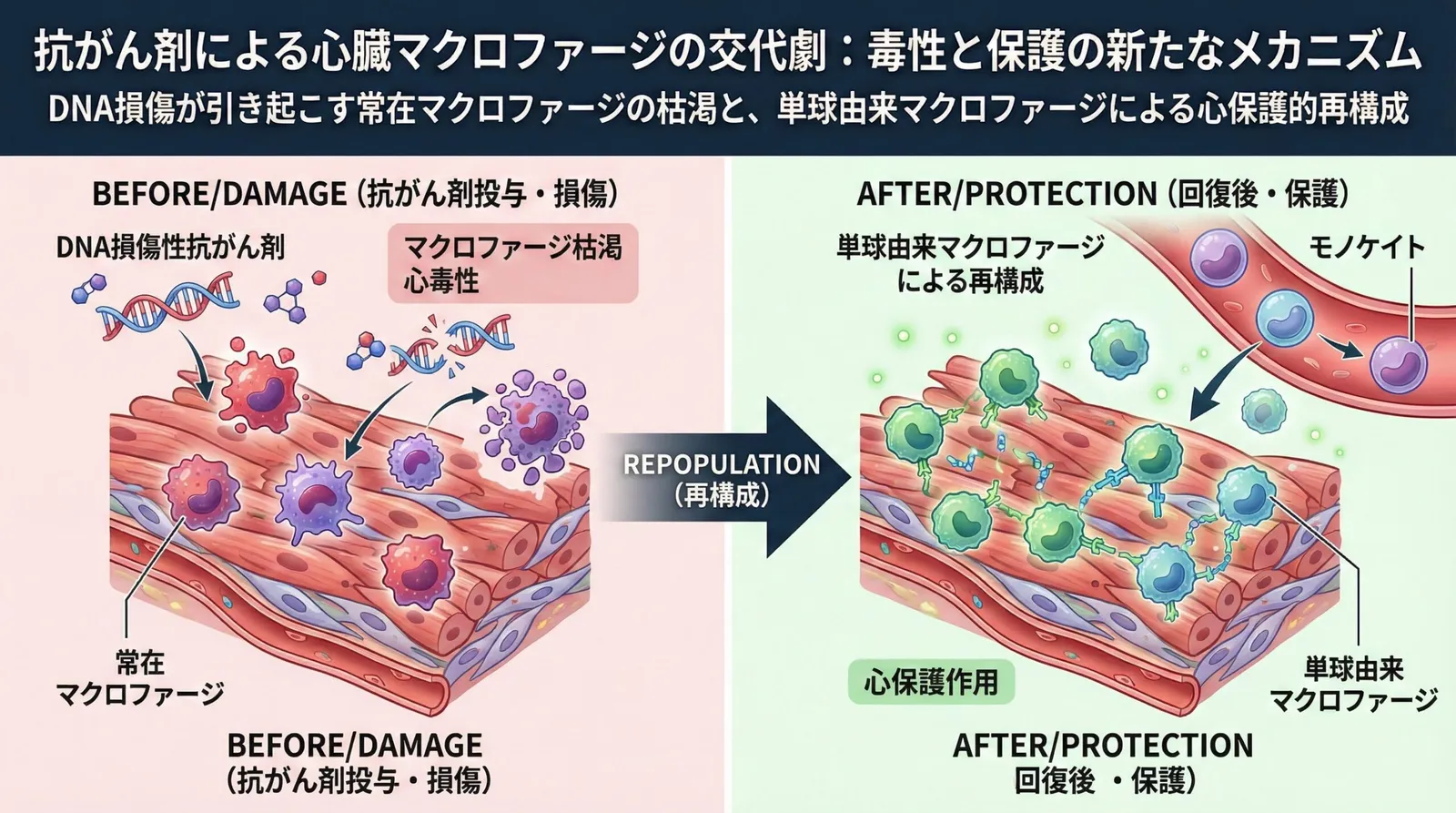
This study reveals that DNA-damaging chemotherapeutic agents dramatically alter the composition and function of cardiac-resident macrophages. Experiments using mouse models demonstrated that chemotherapeutic agents such as doxorubicin activate p53 signaling and induce necroptosis and apoptosis, thereby selectively depleting cardiac-resident macrophages. Interestingly, monocytes subsequently reconstitute the cardiac macrophage compartment, and these monocyte-derived macrophages—unlike the original embryonically derived macrophages—were found to confer protection against hypertension and ischemic heart disease. Furthermore, these monocyte-derived macrophages were shown to suppress inflammation and attenuate myocardial remodeling through a type I interferon-dependent mechanism. This study highlights a previously unrecognized impact of chemotherapeutic agents on the cardiac immune environment and deepens our understanding of monocyte plasticity and the dynamics of resident macrophages.
3. Background
As cancer treatment advances and survival rates improve, cardiotoxicity caused by chemotherapeutic agents has become a major problem. In particular, DNA-damaging chemotherapeutic agents such as doxorubicin are known to increase the risk of heart failure and ischemic heart disease. However, the detailed mechanisms by which these agents affect the cardiac immune environment had not been fully elucidated.
The heart contains immune cells called resident macrophages, which play an important role in maintaining cardiac homeostasis and in tissue repair. Recently, it has been suggested that these macrophages are also involved in the onset and progression of heart disease. Therefore, understanding the impact of chemotherapeutic agents on cardiac-resident macrophages is extremely important for developing strategies to mitigate chemotherapy-induced cardiotoxicity.
4. Key Findings (Molecular, Cellular, and Tissue Levels)
In this study, the researchers used mouse models to analyze in detail the effects of DNA-damaging chemotherapeutic agents such as doxorubicin on cardiac-resident macrophages.
- Selective depletion of cardiac-resident macrophages by chemotherapy: Administration of doxorubicin was confirmed to markedly reduce cardiac-resident macrophages. Investigation of the molecular mechanism revealed that doxorubicin activates p53 signaling and induces necroptosis (programmed cell necrosis) and apoptosis (programmed cell death), thereby selectively eliminating the macrophages. By analogy, it is as if the flowers (macrophages) blooming in the garden that is the heart wither away due to the herbicide that is the chemotherapeutic agent.
- Reconstitution of the cardiac macrophage compartment by monocyte-derived macrophages: It was found that after chemotherapy administration, bone marrow–derived monocytes infiltrate the heart over time and differentiate into macrophages, thereby reconstituting the cardiac macrophage compartment. However, these monocyte-derived macrophages differ from the original embryonically derived macrophages in their gene expression patterns, and functional differences were also suggested. This can be likened to a new kind of flower (monocyte-derived macrophages) being planted in the garden, creating a landscape different from before.
- Cardioprotective effects of monocyte-derived macrophages: Interestingly, monocyte-derived macrophages were found to confer protection against hypertension and ischemic heart disease. These macrophages were shown to promote the production of type I interferon (IFN-I) and suppress inflammation, thereby attenuating myocardial remodeling. It is as if the newly planted flowers (monocyte-derived macrophages) improve the garden’s soil and protect it from pests and diseases.
5. Discussion / Implications from a Specialized Perspective
Anti-aging
This study also offers interesting implications from an anti-aging perspective. It is known that with aging, the function of tissue-resident macrophages declines, causing chronic inflammation. The removal of macrophages by chemotherapeutic agents and their subsequent reconstitution by monocyte-derived macrophages can be regarded as a kind of “macrophage refresh.” However, whether monocyte-derived macrophages can maintain cardiac health over the long term needs to be clarified in future research.
Regenerative Medicine (MSC / EV)
Regenerative medicine using mesenchymal stem cells (MSC) and exosomes (EV) is regarded as promising in the treatment of heart disease. MSC/EV are known to promote tissue repair through immunomodulatory effects, and one of the mechanisms may involve the regulation of macrophage function. The results of this study may provide important information for developing new strategies to enhance the efficacy of MSC/EV-based cardiac regenerative therapy.
Neuro-Organ Crosstalk
In recent years, the interactions between the nervous system and organs have attracted attention. Nerve fibers are also distributed in the heart and are involved in regulating cardiac function. It is conceivable that changes in cardiac-resident macrophages caused by chemotherapeutic agents may affect the function of the cardiac nervous system. For example, cytokines produced by macrophages might alter neurotransmission or influence the survival of nerve cells. This point needs to be investigated in more detail in future research.
7. Future Prospects
This study sheds new light on the mechanisms of chemotherapy-induced cardiotoxicity and may lead to the development of new therapeutic strategies to reduce the cardiovascular disease risk of cancer survivors.
- Selective macrophage regulation: If we can control the differentiation of monocytes infiltrating the heart and increase the proportion of macrophages with cardioprotective effects, it may be possible to reduce chemotherapy-induced cardiotoxicity.
- Type I interferon therapy: By developing drugs that promote the production of type I interferon by monocyte-derived macrophages, it may be possible to suppress myocardial remodeling and improve cardiac function.
- Personalized medicine: Personalized medicine—selecting the optimal chemotherapeutic agent according to the patient’s genetic background and immune status, or combining it with cardioprotective therapy—may become important.
8. Conclusion
This study revealed that DNA-damaging chemotherapeutic agents dramatically alter the composition and function of cardiac-resident macrophages. The macrophage compartment depleted by chemotherapeutic agents is subsequently reconstituted by monocyte-derived macrophages, and these macrophages were shown to confer cardioprotective effects, unlike the original macrophages. This study sheds new light on the mechanisms of chemotherapy-induced cardiotoxicity and may lead to the development of new therapeutic strategies to reduce the cardiovascular disease risk of cancer survivors.
Going forward, further research is needed on the long-term effects of monocyte-derived macrophages and their interactions with the nervous system.