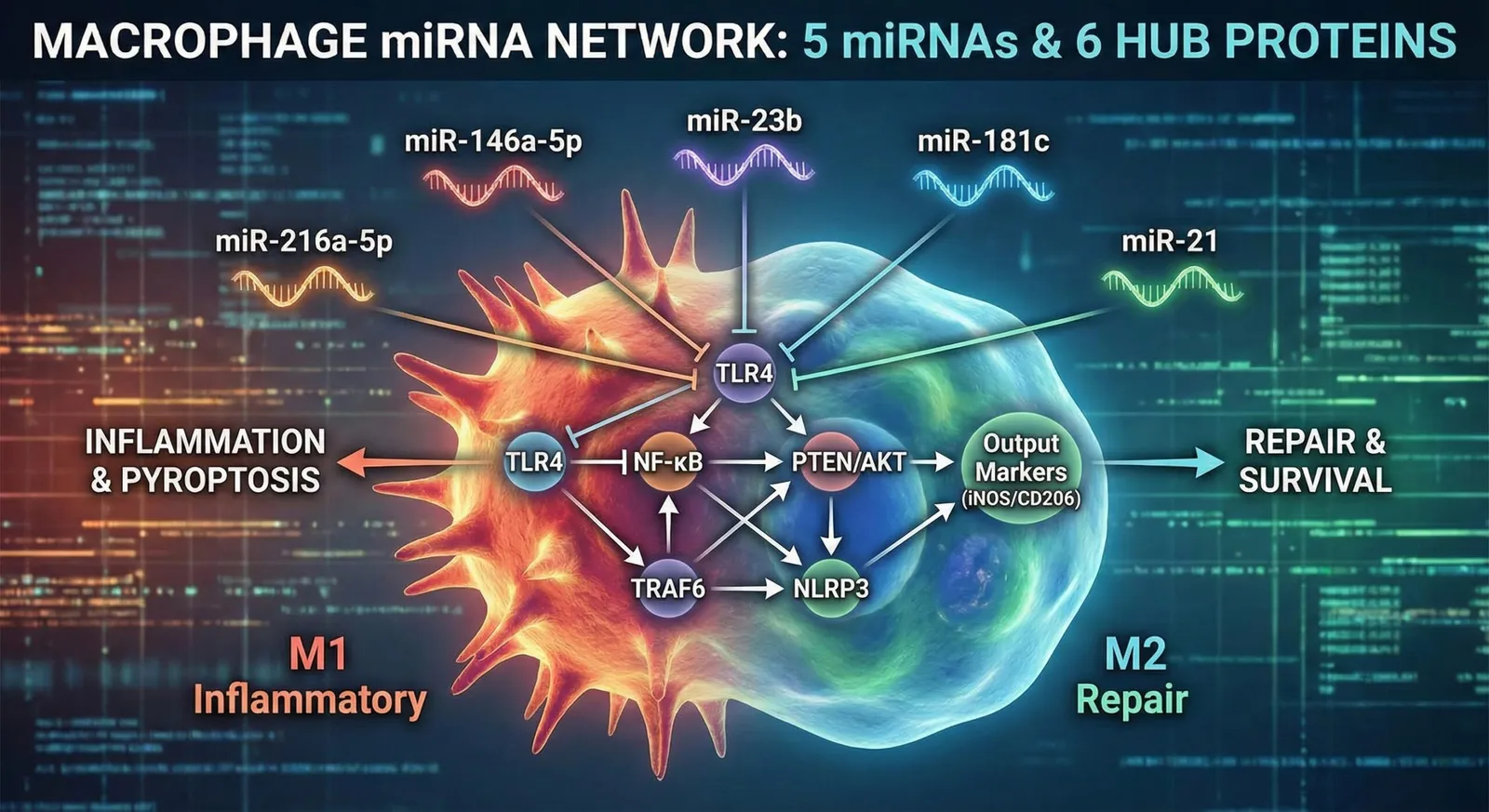
In the phenotypic control of macrophages (RAW264.7, THP-1, Kupffer cells, etc.), which proteins do specific miRNAs (miRNA) target, and what fate (inflammation, M1/M2 polarization, pyroptosis, etc.) do they ultimately drive?
This time, based on the literature (PubMed reports), we pick out 5 noteworthy miRNAs (miR‑216a‑5p / miR‑146a‑5p / miR‑23b / miR‑181c / miR‑21). For each, we organize the “top 5 target proteins” and the **“convergence points (hubs) of signal transduction”** on which they commonly act.
1. The Crux of the Network: The “6 Convergence Points” Shared by All miRNAs
Surveying the proteins controlled by the 5 miRNAs, it becomes clear that macrophage fate determination is not a matter of scattered pathways but converges on the control of the following major “hubs.” By controlling these, powerful phenotypic changes are induced.
- NF‑κB (p65/p‑NF‑κB): The most important switch for inflammatory transcription
- TLR4: The most upstream receptor of inflammatory signaling
- TRAF6 / IRAK1: The amplifiers of TLR4 signaling
- PTEN ↔ PI3K/AKT: The antagonistic axis of survival/repair (M2) signaling
- NLRP3 inflammasome: The executor of inflammatory cell death (pyroptosis) and IL-1β maturation
- Output marker groups: M1 (iNOS, TNF-α) vs M2 (CD206, IL-10)
2. Target Proteins and Phenotype Details of Each miRNA
Below, for each miRNA, we explain “the 5 molecules whose protein amount/activity is reported to change” and the phenotype that results.
① miR‑216a‑5p: Dual Control of TLR4 Blockade and AKT Activation
(Main reports: Kupffer cells, BMDM systems)
This miRNA shows the typical “M2-inducing” behavior of cutting off the inflammatory input (TLR4) while driving survival/repair (AKT).
- TLR4 [direct target]: Downstream signaling is blocked through suppression of expression.
- NF‑κB p65 (phosphorylated): The activated form decreases in line with TLR4 suppression.
- AKT (phosphorylated): p-AKT rises (enhancement of anti-inflammatory/survival signaling).
- iNOS (NOS2): Decrease of the M1 marker.
- CD206 (MRC1): Increase of the M2 marker and of Arg1.
Phenotype summary Through TLR4↓ and p‑NF‑κB↓ together with p‑AKT↑, inflammatory cytokines are suppressed while strongly driving toward M2 polarization (iNOS↓ and CD206↑).
② miR‑146a‑5p: The “Brake” of Inflammation and NLRP3 Control
(Main reports: RAW264.7, asthma/lung models)
Famous as a “negative regulator of inflammation,” its characteristic is directly hitting the amplification part of TLR4 signaling (TRAF6/IRAK1).
- TRAF6 [direct target]: Expression suppressed through 3’UTR binding.
- IRAK1: Suppressed together with TRAF6, attenuating TLR4 signaling.
- TLR4: A decrease at the protein level is observed in conjunction with downstream factors.
- NF‑κB (nuclear translocation/activity): Activation and nuclear translocation are inhibited.
- NLRP3: Inflammasome activation is suppressed, contributing to M1 suppression / M2 promotion.
Phenotype summary Starting from suppression of TRAF6/IRAK1 (direct targets), it doubly suppresses both NF‑κB output and the NLRP3 inflammasome. It exhibits a powerful anti-inflammatory (TNF-α↓, IL-10↑) effect.
③ miR‑23b: Beware the “Duality” That Changes With the Target
(Main reports: THP-1, microglia/macrophage)
Because the action of this miRNA reverses depending on “what it targets (the cellular environment),” care is needed in interpretation.
- NF‑κB p65: There are reports of activation (pro-inflammatory) via A20 suppression.
- A20 (TNFAIP3) [direct target]: A system that suppresses A20, the brake on NF-κB, and thereby promotes inflammation.
- ADAM10 [direct target]: When this is targeted, it suppresses inflammation and apoptosis.
- PTEN [direct target]: PTEN suppression affects the Nrf2 pathway and pyroptosis.
- NLRP3: In conjunction with PTEN targeting, it suppresses pyroptosis (GSDMD-N, IL-1β).
Points of interpretation
- Pro-inflammatory route: Suppress A20 → NF‑κB activation
- Anti-inflammatory/cytoprotective route: Suppress ADAM10 or PTEN → suppression of inflammation and pyroptosis. Note: It is necessary to determine which pathway is dominant in a given experimental system.
④ miR‑181c: Simple Suppression of the TLR4/NF‑κB Axis
(Main reports: RAW264.7)
Rather than complex branching, the main reports describe straightforwardly suppressing the TLR4-NFκB axis.
- TLR4: Suppressed by treatment with MSC-derived exosomes, etc.
- NF‑κB p65 (and p-p65): Activity decreases.
- TNF‑α: Production decreases.
- IL‑1β: Production decreases.
- IL‑10: Production increases.
Phenotype summary In line with TLR4/NF‑κB suppression, M1-type cytokines (TNF-α/IL-1β) decrease and M2-type (IL-10) increases, showing an anti-inflammatory profile.
③ miR‑21: The Key to “M2/TAM Conversion” Through PTEN Suppression
(Main reports: tumor-associated macrophages (TAM), infection models)
Frequently appearing in the context of cancer immunity. By suppressing PTEN and driving AKT, it transforms macrophages into “M2-like (or immunosuppressive TAM).”
- PTEN: Suppressed, releasing the brake on the PI3K/AKT pathway.
- PI3K / p‑AKT: Activated in line with PTEN suppression (signal enhancement).
- STAT3: Expression/activity increases (the main transcription factor for M2 conversion).
- PDCD4: An amplifier of TLR4 signaling. Suppressing it negatively controls the excessive activation of NF-κB.
- IL‑10: As a result of PDCD4 suppression, IL-10 production tends to be maintained/promoted.
Phenotype summary Through the pathway PTEN↓ → PI3K/AKT↑ → STAT3↑, it powerfully promotes M2/TAM conversion (immunosuppression). During infection, it also functions as a brake on excessive inflammation through PDCD4 suppression.
3. Integrated Model: The “2 Switches” Operated by These 5 miRNAs
Integrating the above information, these 5 miRNAs can be said to change the macrophage phenotype by operating, broadly speaking, 2 switches.
Switch A: Blockade of the Inflammatory Circuit (TLR4 → NF‑κB OFF)
- Responsible: miR‑216a‑5p, miR‑146a‑5p, miR‑181c, miR‑21 (in part)
- Mechanism: By hitting TLR4, TRAF6, PDCD4, etc., it stops the nuclear translocation of NF-κB and the production of inflammatory cytokines (TNF-α, IL-1β).
- Result: Resolution of acute inflammation.
Switch B: Activation of the Repair/Survival Circuit (PTEN → AKT ON)
- Responsible: miR‑21, miR‑216a‑5p, miR‑23b (in part)
- Mechanism: By hitting PTEN, it activates PI3K/AKT signaling.
- Result: Increase of M2 markers (CD206, Arg1), a shift toward cell survival and tissue repair (or tumor promotion).
4. Key References (Key PubMed IDs)
The main reports used to organize this article are as follows. Please check the original works for detailed experimental conditions.
- miR-21 / PDCD4 axis (TLR4 negative feedback): Sheedy et al., 2010 (PMID: 19946272)
- miR-21 / PTEN axis (M2/TAM induction): Lin et al., 2020 (PMID: 31814034)
- miR-146a-5p / NLRP3・M2 axis (asthma model): Li et al., 2022 (PMID: 35660690)
- miR-146a-5p / NLRP3 axis (NEC/THP-1): He et al., 2021 (PMID: 33585442)
- miR-23b / ADAM10 axis (anti-inflammatory): Zhang et al., 2019 (PMID: 31780861)
This blog post organizes a specific miRNA network in macrophages based on the latest PubMed literature. Because behavior may differ depending on the experimental system (cell type or stimulus), please exercise caution when conducting validation experiments.