1. Title
TGFβ signaling mediates microglial resilience to spatiotemporally restricted myelin degeneration
2. Journal Information
- Article link: https://doi.org/10.1038/s41593-025-01955-w
- Journal: Nature Neuroscience
- Impact Factor: approximately 29 (one of the top journals in neuroscience. It covers a wide range of fields including molecular neuroscience, cellular neuroscience, and systems neuroscience, and tends to publish papers that present particularly innovative discoveries or new paradigms.)
3. Summary
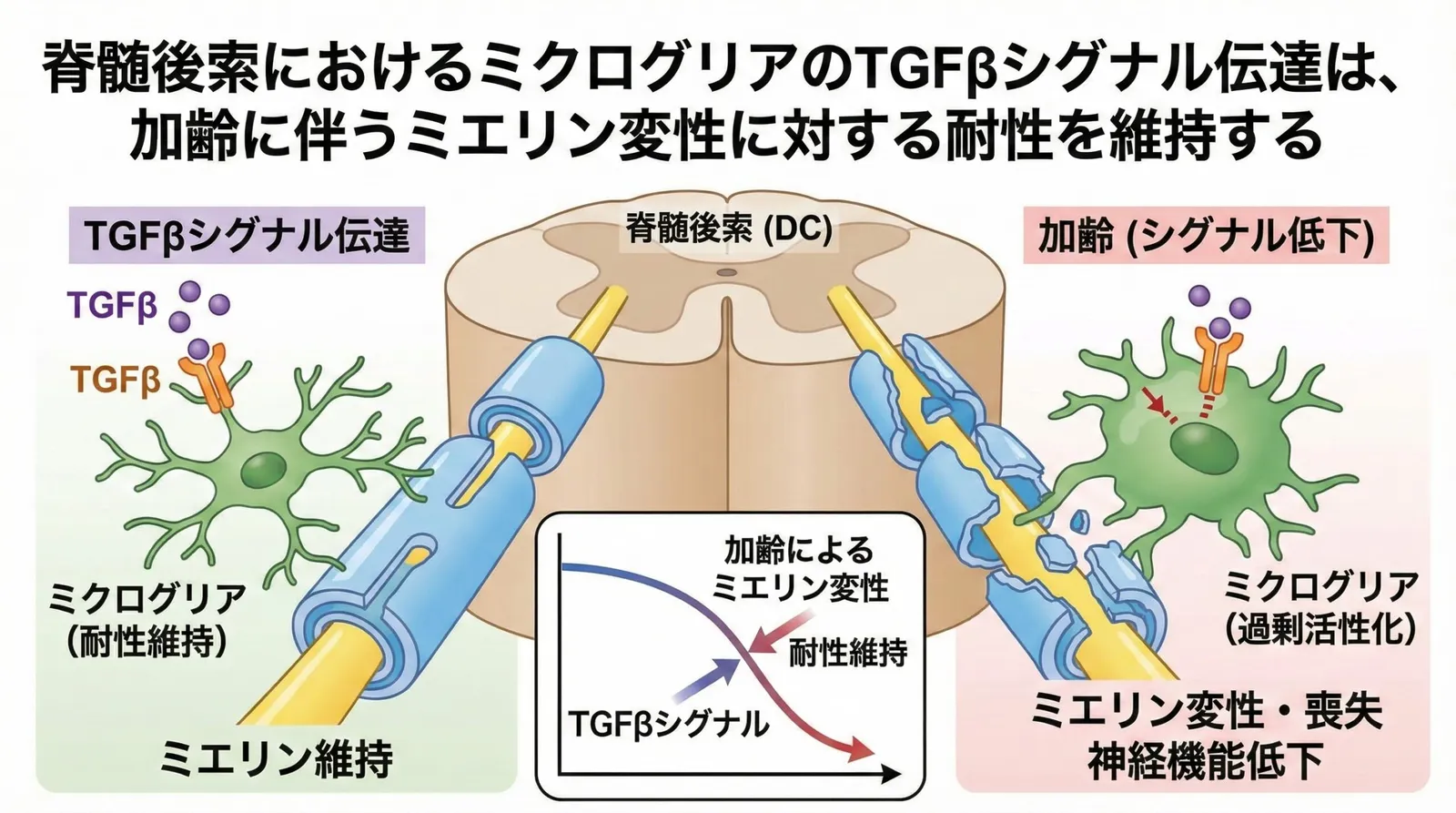
This study provides a detailed analysis, from the perspective of TGFβ signaling, of the microglial response to myelin degeneration in the spinal dorsal column (DC) with aging. Microglia are the immune cells of the central nervous system and play an important role in the maintenance and repair of myelin, but their function is known to change with aging. In this study, the authors found that myelin degeneration progresses in the DC with aging, and that TGFβ signaling in DC microglia is activated accordingly. Furthermore, they showed that inhibiting TGFβ signaling in microglia causes microglia to become overactivated, worsening myelin loss and neurological impairment. Single-cell RNA sequencing analysis revealed that a microglial subset sensitive to TGFβ signaling and a disease-associated oligodendrocyte subset are localized in the DC. These results suggest that TGFβ signaling plays an important role in maintaining microglial resilience to age-associated myelin degeneration.
4. Background
Myelin in the central nervous system is an essential structure that covers the axons of neurons and enables efficient nerve transmission. Degeneration of myelin can cause neurodegenerative diseases such as multiple sclerosis. Microglia are the immune cells of the central nervous system and play a wide variety of roles, including maintaining tissue homeostasis, removing pathogens, and clearing cellular debris. In recent years, it has become clear that microglia are also involved in the maintenance and repair of myelin. However, the molecular mechanism by which microglia monitor the state of myelin and trigger an appropriate response has not yet been fully elucidated. In particular, much remains unclear about the relationship between age-associated changes in microglial function and myelin degeneration. TGFβ signaling is an important signaling pathway that regulates various cellular processes, including cell proliferation, differentiation, apoptosis, and immune responses. In the central nervous system, TGFβ signaling is known to suppress the activation of microglia and play a role in calming inflammation. However, how TGFβ signaling is involved in the maintenance of myelin via microglia had not been sufficiently studied until now.
5. Key Findings (Molecular, Cellular, and Tissue Levels)
In this study, the following key findings were obtained.
- Myelin degeneration progresses selectively in the spinal dorsal column (DC) with aging: Compared with young mice, the DC of aged mice showed a reduction in myelin thickness and abnormalities in myelin structure. This suggests that the DC becomes vulnerable to myelin degeneration with aging. The spinal cord is responsible for transmitting sensory information from the body to the brain. Among its pathways, the DC transmits important sensory information such as touch and proprioception, and a decline in its function has a major impact on daily life. For example, symptoms such as becoming unsteady on one’s feet or having difficulty with fine tasks as one ages are thought to be partly caused by a decline in DC function.
- TGFβ signaling is activated in DC microglia: In the DC microglia of aged mice, the expression of TGFβ receptors and downstream signaling molecules was increased. This suggests that microglia become dependent on TGFβ signaling with aging. TGFβ signaling plays a role in suppressing the activation of microglia and calming inflammation. This is like a parent soothing a child who is being too rowdy. If TGFβ signaling is functioning normally, microglia contribute to maintaining tissue homeostasis without becoming activated more than necessary.
- Inhibition of TGFβ signaling in microglia worsens myelin loss and neurological impairment: In mice with a microglia-specific deletion of the TGFβ receptor, age-associated myelin loss in the DC was promoted, and declines in touch and motor function were observed. This shows that TGFβ signaling is essential for the maintenance of myelin via microglia. If TGFβ signaling does not function properly, microglia become overactivated, releasing inflammatory cytokines and damaging surrounding cells. This is like a parent scolding a child too harshly, which instead provokes a backlash.
- Single-cell RNA sequencing analysis revealed that a microglial subset sensitive to TGFβ signaling and a disease-associated oligodendrocyte subset are localized in the DC: This suggests that specific microglial and oligodendrocyte populations may be involved in myelin degeneration in the DC. In recent years, the development of single-cell analysis technology has revealed that diverse subsets exist within cell populations that were previously considered uniform. The results of this study suggest that DC microglia may also contain subsets with different sensitivities to TGFβ signaling, and that these may have different effects on the progression of myelin degeneration. In addition, the existence of disease-associated subsets among oligodendrocytes provides an important clue for understanding the mechanism of myelin degeneration.
- Microglia use a TGFβ autocrine mechanism to prevent myelin damage in the DC: This means that microglia themselves produce TGFβ and, by receiving it, regulate themselves. If this self-regulatory mechanism breaks down, microglia may become overactivated and attack myelin.
6. Discussion / Implications
Anti-aging
This study revealed that TGFβ signaling plays an important role in the microglial response to age-associated myelin degeneration. If TGFβ signaling declines with aging, microglia may become overactivated and attack myelin. Therefore, maintaining or enhancing TGFβ signaling may become a new strategy for suppressing age-associated myelin degeneration and preserving neurological function. For example, the development of TGFβ receptor agonists or drugs that activate the TGFβ signaling pathway can be envisioned. However, since TGFβ signaling regulates various cellular processes such as cell proliferation and immune responses, attention must be paid to side effects.
Neuro–Organ Crosstalk
This study suggests that the function of microglia in the central nervous system may be closely related to the systemic physiological state. Age-associated myelin degeneration may cause not only a decline in neurological function but also various systemic symptoms such as a decline in motor function and cognitive function. Therefore, controlling the function of microglia may lead not only to neurodegenerative diseases but also to the prevention and treatment of various age-associated diseases. In recent years, the “gut–brain axis,” in which the gut microbiota affects brain function, has attracted attention, and microglia may also be an important mediator of it.
7. Future Prospects
This study revealed that TGFβ signaling is important for maintaining microglial resilience to age-associated myelin degeneration. In future research, the following points are considered to be important.
- Detailed analysis of the molecules involved in TGFβ signaling
- Development of therapies targeting TGFβ signaling
- Elucidation of the function of microglial subsets
- Elucidation of the interaction between microglia and oligodendrocytes
- Elucidation of the relationship between the systemic physiological state and microglial function
Through this research, it is hoped that the mechanism of age-associated myelin degeneration will be more deeply understood, contributing to the prevention and treatment of neurodegenerative diseases.
8. Conclusion
This study revealed that microglia maintain resilience to myelin degeneration in the aging spinal dorsal column via TGFβ signaling. This finding is an important step toward understanding the mechanism of age-associated decline in neurological function, and may open a new path for the future prevention and treatment of neurodegenerative diseases.