Journal Information
- Article link: 10.1038/s41591-025-04038-2
- Journal: Nature Medicine
- Impact Factor: approximately 87.0 (Nature Portfolio)
- About the journal: Nature Medicine is one of the top journals in the field of medicine, publishing groundbreaking papers across a wide range of fields from basic research to clinical research. Studies that lead to the elucidation of disease mechanisms and the development of new therapies are particularly highly regarded.
Summary
This study aims to identify blood biomarkers associated with multimorbidity in older adults and to clarify their shared and specific features. Using data from a Swedish cohort study of older adults (SNAC-K) and the Baltimore Longitudinal Study of Aging (BLSA), the authors analyzed the associations between 54 blood biomarkers related to inflammation, vascular function, metabolism, and neurodegeneration, and indicators of multimorbidity (number of diseases, disease patterns, and rate of disease accumulation). The results showed that GDF-15, HbA1c, cystatin C, leptin, and insulin were commonly associated with various indicators of multimorbidity. Furthermore, gamma-glutamyl transferase (GGT) and albumin were found to show positive and negative correlations, respectively, with the rate of disease accumulation. These findings suggest that the pathology of multimorbidity may involve both shared mechanisms and mechanisms specific to particular disease patterns, and indicate that metabolic dysregulation is an important driver of multimorbidity.
Background
Aging is accompanied by declining physiological function and an increased risk of developing multiple chronic diseases. Multimorbidity is a major factor that significantly impairs the healthy life expectancy of older adults and also contributes to rising healthcare costs. However, the biological basis of multimorbidity is still not sufficiently understood. In recent years, advances in aging research have drawn attention to inflammation, oxidative stress, and metabolic dysregulation as shared mechanisms involved in the onset of age-related diseases. It is conceivable that these mechanisms are also involved in multimorbidity. In this study, the authors comprehensively analyze the pathology of multimorbidity using blood biomarkers that reflect a variety of biological processes, with the goal of elucidating its fundamental mechanisms.
Lab & Authors
One of the corresponding authors of this study is Dr. Anna-Karin Welmer, who is affiliated with the Karolinska Institute in Sweden. Her laboratory conducts a wide range of epidemiological research on the health and aging of older adults. In particular, it focuses on age-related health problems such as multimorbidity, frailty, and cognitive decline, working to elucidate their risk factors and prevention strategies. Dr. Welmer’s laboratory leads a large-scale cohort study of older adults called SNAC-K, and this study is also based on its data. SNAC-K follows several thousand older adults over a long period, investigating in detail their health status, lifestyle, cognitive function, and biological markers, with the goal of elucidating the mechanisms of aging and the factors that influence healthy life expectancy.
Dr. Welmer herself is a leading expert in epidemiological research on the health of older adults and has published numerous papers in fields such as multimorbidity, frailty, and dementia. Her research contributes to the development of policies and intervention strategies for promoting the health of older adults and is highly regarded internationally. Her achievements have become indispensable to solving the health challenges of an aging society.
One researcher worth noting among the authors of this study is the co-first author, Dr. Linnea Järeholm. She is a researcher affiliated with Dr. Welmer’s laboratory and specializes in the epidemiological research of multimorbidity. Dr. Järeholm has used SNAC-K data to analyze in detail the risk factors, disease patterns, and prognosis of multimorbidity, and has published her research findings in numerous papers. The combination of her expertise and the resources of Dr. Welmer’s laboratory ensures the high quality of this study.
Key Findings – at the Molecular, Cellular, and Tissue Levels
The following major findings were obtained in this study.
-
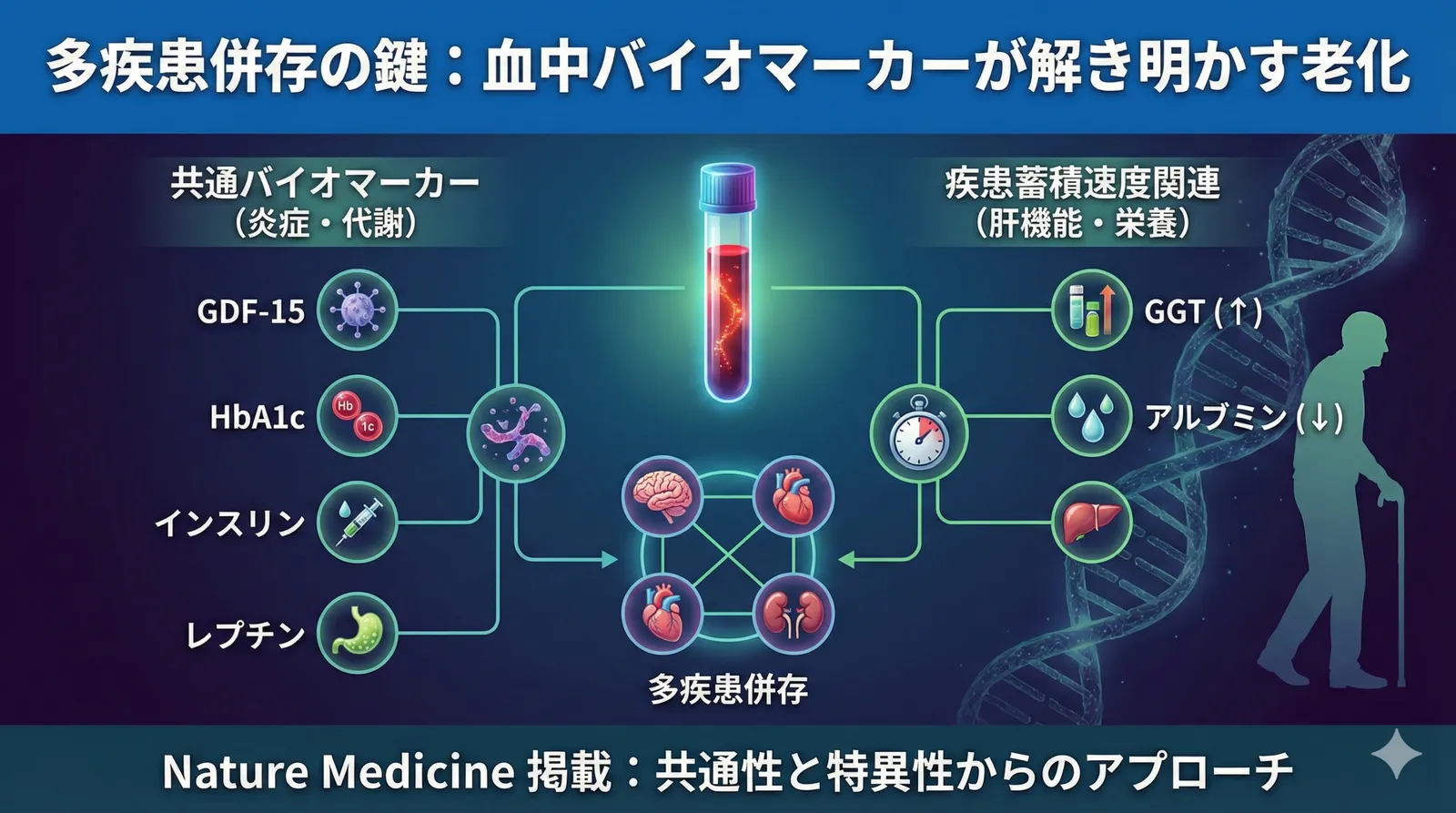
Biomarkers commonly associated with indicators of multimorbidity: GDF-15, HbA1c, cystatin C, leptin, and insulin were identified as biomarkers showing a consistent positive correlation with all of the indicators—number of diseases, disease patterns, and rate of disease accumulation. These biomarkers reflect a variety of biological processes such as inflammation, metabolic dysregulation, and declining kidney function, suggesting that multiple factors may be intricately involved in the pathology of multimorbidity.
- GDF-15 (Growth Differentiation Factor 15): A cytokine involved in the cellular stress response and inflammation, induced by mitochondrial dysfunction and tissue damage. It is known to be elevated in many diseases, including cardiovascular disease, cancer, and neurodegenerative diseases. By way of analogy, GDF-15 is like an alarm indicating that cells are sending out an SOS signal.
- HbA1c (Hemoglobin A1c): An indicator that reflects the average blood glucose level over the past two to three months, used for the diagnosis of diabetes and as an indicator of blood glucose control. High HbA1c indicates a chronically high blood glucose state, which can cause damage to vascular endothelial cells and inflammation. HbA1c is like a “glycation meter” indicating the state of sugar-soaked blood vessels.
- Cystatin C: A low-molecular-weight protein produced in the kidneys, used as an indicator of the glomerular filtration rate (GFR). When kidney function declines, the blood concentration of cystatin C rises. Cystatin C is like the “fineness of the mesh of a sandbox,” indicating the filtering capacity of the kidneys.
- Leptin: A hormone secreted by fat cells that acts to suppress appetite and regulate energy expenditure. In obesity and insulin resistance, leptin resistance occurs and the effect of leptin is attenuated. Leptin is like an “appetite-suppression messenger” that conveys a feeling of satiety.
- Insulin: A hormone secreted by the pancreas that acts to lower blood glucose levels. Insulin resistance and insufficient insulin secretion are involved in the onset of type 2 diabetes. Insulin is like a “key” for taking blood glucose into cells.
-
Biomarkers specifically associated with the rate of disease accumulation: The rate of disease accumulation was found to show a positive correlation with gamma-glutamyl transferase (GGT) and a negative correlation with albumin. These biomarkers reflect liver function and nutritional status, suggesting that they may influence the progression of disease.
- GGT (Gamma-Glutamyl Transferase): An enzyme present in the liver and biliary tract that is elevated by liver dysfunction and alcohol consumption. GGT is like the “volume of factory wastewater,” indicating the detoxifying action of the liver.
- Albumin: A protein synthesized in the liver that acts to maintain osmotic pressure in the blood. Hypoalbuminemia is caused by malnutrition, inflammation, liver dysfunction, and other factors. Albumin is like a “sponge” that retains water in the blood.
Discussion / Implications
The findings of this study provide a new perspective on the pathology of multimorbidity.
Anti-aging
The biomarkers identified in this study suggest a link between the aging process and multimorbidity. GDF-15 is a factor involved in the cellular stress response, and its expression is known to increase with aging. In addition, HbA1c and insulin reflect the decline in metabolic function that accompanies aging and increase the risk of developing lifestyle-related diseases such as diabetes. Interventions targeting these biomarkers may slow the progression of aging and prevent multimorbidity.
Regenerative Medicine (MSC / EV)
In recent years, regenerative medicine using mesenchymal stem cells (MSC) and exosomes / extracellular vesicles (EV) has been attracting attention as a treatment for various diseases. MSCs and EVs are known to have anti-inflammatory and tissue-repair effects and may also be applicable to the treatment of age-related diseases. The biomarkers identified in this study may be used as indicators for evaluating the effects of MSC/EV therapy. For example, a decrease in GDF-15 or an increase in albumin may indicate a reduction in cellular stress and an improvement in nutritional status brought about by MSC/EV therapy.
Neuro–Organ Crosstalk
The biomarkers identified in this study suggest a connection between the nervous system and other organs. GDF-15 has been reported to have neuroprotective effects and to improve cognitive function after stroke. In addition, insulin resistance is known to increase the risk of developing Alzheimer’s disease. These findings suggest that interactions between the nervous system and other organs may influence the onset and progression of multimorbidity. Treatment strategies that take neuro–organ crosstalk into account may be effective in preventing and improving multimorbidity.
Future Prospects
The findings of this study may lead to future research and clinical applications.
- Development of risk-prediction models for multimorbidity: Using the biomarkers identified in this study, it is hoped that models can be developed to predict the risk of developing multimorbidity. This would make it possible to identify high-risk individuals at an early stage and provide preventive interventions.
- Search for new therapeutic targets: The development of new therapies targeting the biomarkers identified in this study is anticipated. For example, GDF-15 inhibitors and drugs that improve insulin sensitivity are promising as therapeutic agents for multimorbidity.
- Realization of personalized medicine: The biomarkers identified in this study may be used as indicators for predicting an individual’s disease risk and treatment response. This is expected to contribute to the realization of personalized medicine, in which the optimal treatment is selected for each patient.
Conclusion
This study comprehensively analyzed the blood biomarkers associated with multimorbidity in older adults and clarified their shared and specific features. The results showed that GDF-15, HbA1c, cystatin C, leptin, and insulin were commonly associated with various indicators of multimorbidity. Furthermore, gamma-glutamyl transferase (GGT) and albumin were found to show positive and negative correlations, respectively, with the rate of disease accumulation. These findings suggest that the pathology of multimorbidity may involve both shared mechanisms and mechanisms specific to particular disease patterns, and indicate that metabolic dysregulation is an important driver of multimorbidity. The results of this study are expected to contribute to the development of new strategies for the prevention and treatment of multimorbidity.