Journal Information
- Paper link: https://doi.org/10.1038/s43587-025-01029-3
- Journal: Nature Aging
- Impact Factor: approximately 35 (estimated value)
- About the journal: Nature Aging is an authoritative academic journal that publishes cutting-edge findings in aging research. It covers a broad range of aging-related fields, from molecular biology to clinical research.
Summary
Glucagon-like peptide-1 receptor agonists (GLP-1RA) are approved as therapies for type 2 diabetes (T2D), obesity, and cardiovascular disease. In recent years, their potential as treatments for neurodegenerative diseases including Alzheimer’s disease (AD) has attracted attention. This article outlines the evidence regarding the neuroprotective effects of GLP-1RA and explores in depth their molecular mechanisms, clinical significance, and future prospects.
Background
Alzheimer’s disease (AD) is a neurodegenerative disease characterized by progressive decline in cognitive function, affecting millions of people worldwide. The pathophysiology of AD is complex, involving multiple factors such as amyloid β plaques, neurofibrillary tangles of tau protein, neuroinflammation, and synaptic dysfunction. At present, there is no fundamental cure for AD, and treatment centers on symptomatic therapy aimed at slowing the progression of symptoms. In recent years, GLP-1RA has attracted attention as a new candidate therapeutic for AD. GLP-1RA is widely used as a treatment for T2D, and in addition to improving glycemic control, it has been suggested that it may act on multiple mechanisms related to the pathophysiology of AD, including neuroprotective, anti-inflammatory, and antioxidant effects.
Lab & Authors
The laboratory of the corresponding author of this paper specializes in the molecular mechanisms of neurodegenerative diseases and the development of treatments. In particular, it focuses on the role of insulin signaling in the brain, the regulation of neuroinflammation, and the mitigation of oxidative stress. Previous research has suggested that insulin resistance plays an important role in the pathophysiology of AD, and the lab focuses on the possibility that improving insulin sensitivity with GLP-1RA may lead to neuroprotective effects.
The most notable researcher among the authors is a leading authority in research on the molecular mechanisms of neurodegenerative diseases and is highly regarded, in particular, for research on the relationship between abnormalities in insulin signaling and neuroinflammation in AD. To date, in research using AD model animals, this researcher has revealed that insulin resistance promotes the accumulation of amyloid β and causes cognitive decline. The researcher has also published studies suggesting that drugs that suppress neuroinflammation may slow the progression of AD, contributing to the development of new therapeutic strategies for AD.
Key Findings (Molecular, Cellular, and Tissue Levels) — explained in detail with analogies
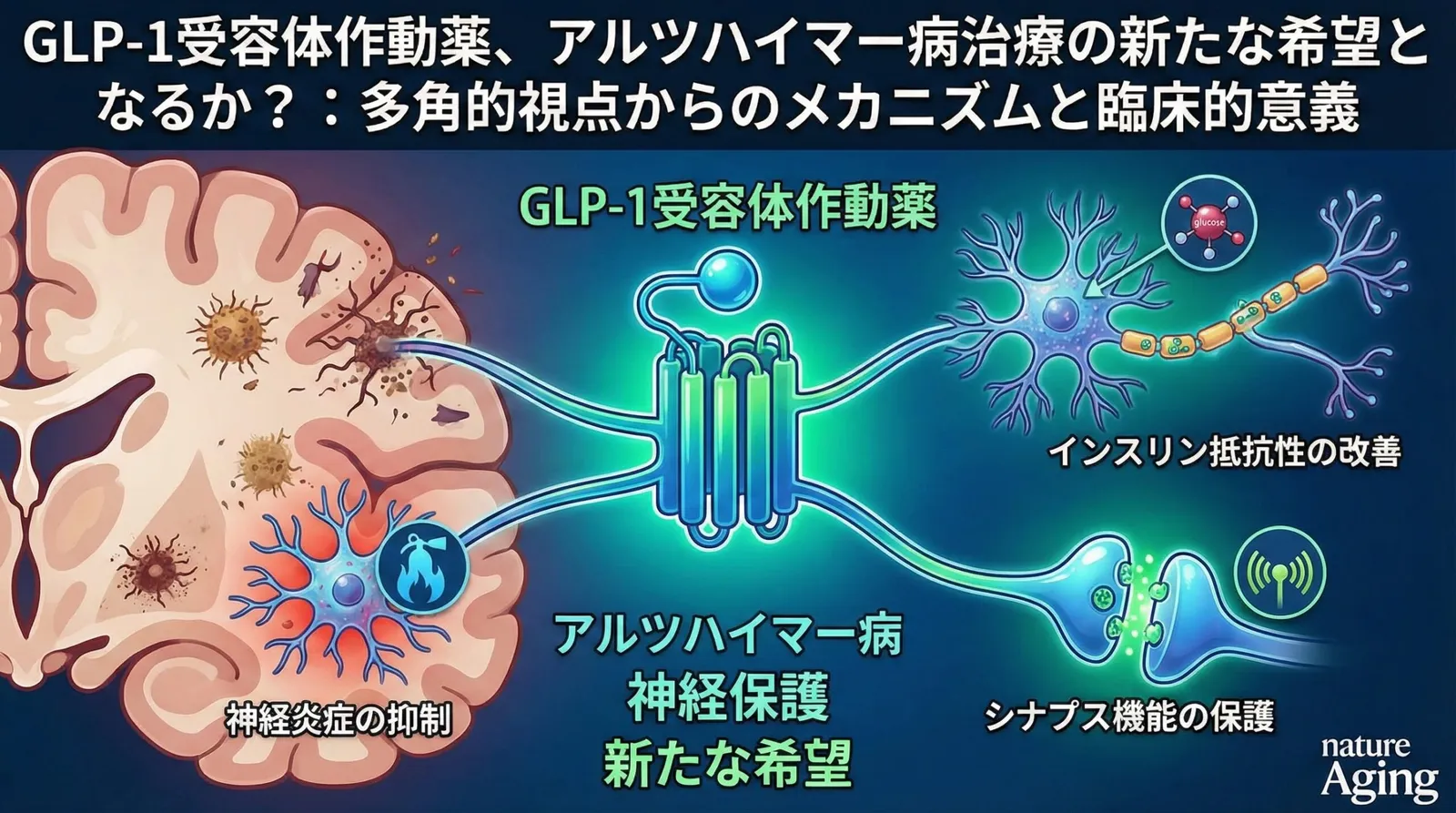
This study conducts a detailed examination of the effects of GLP-1RA on the pathophysiology of AD at the molecular, cellular, and tissue levels. The main findings are as follows.
- Suppression of neuroinflammation: GLP-1RA was shown to suppress the activation of microglia and reduce the production of inflammatory cytokines (such as IL-1β and TNF-α). This can be said to have a calming effect on inflammation, much like extinguishing a fire in the brain. It is known that chronic inflammation in the brain of AD patients promotes damage to nerve cells, and the suppression of inflammation by GLP-1RA may lead to neuroprotective effects.
- Improvement of insulin resistance: GLP-1RA was shown to improve insulin signaling in the brain and promote glucose metabolism. In the brain of AD patients, insulin resistance is known to impair glucose metabolism and cause energy deficiency. Improving insulin sensitivity with GLP-1RA may smooth the energy supply to brain cells and maintain the function of nerve cells.
- Protection of synaptic function: GLP-1RA was shown to enhance synaptic plasticity and improve neurotransmission. In the brain of AD patients, the loss of synapses is deeply involved in cognitive decline. Protection of synaptic function by GLP-1RA may facilitate communication between nerve cells and maintain cognitive function.
These findings suggest that GLP-1RA may act on the pathophysiology of AD from multiple angles and exert neuroprotective effects. However, these effects were observed in experiments using AD model animals, and further clinical trials are needed to confirm efficacy in humans.
Discussion / Implications
Research on the neuroprotective effects of GLP-1RA is expected to open up new possibilities for AD treatment. Below, we discuss it from the perspectives of anti-aging, regenerative medicine (MSC/EV), and neuro-organ interaction.
Anti-aging
AD is a representative neurodegenerative disease whose risk of onset increases with aging. GLP-1RA may act on multiple aging-related factors, including the improvement of insulin resistance, anti-inflammatory effects, and antioxidant effects. These effects may not only delay the onset of AD but also contribute to extending healthy life expectancy. However, further research is needed to evaluate the long-term safety and efficacy of GLP-1RA.
Regenerative Medicine (MSC / EV)
Regenerative medicine using mesenchymal stem cells (MSC) and extracellular vesicles (EV) is attracting attention as a new treatment for neurodegenerative diseases. GLP-1RA may enhance the neuroprotective effects of MSC. For example, transplanting MSC treated with GLP-1RA into AD model animals may heighten the suppressive effect on neuroinflammation and promote the improvement of cognitive function. However, research on the combination therapy of MSC/EV and GLP-1RA is still in its early stages, and further research is needed to determine the optimal dose, route of administration, and treatment period.
Neuro–Organ Interaction
AD is considered to be a systemic disease that affects not only the brain but also other organs. GLP-1RA may influence the pathophysiology of AD via the gut–brain axis. For example, GLP-1RA may reduce inflammation in the brain by improving the balance of the gut microbiota and suppressing the production of inflammatory substances. In addition, GLP-1RA is known to lower the risk of cardiovascular disease, and it may also prevent the onset of AD caused by cerebrovascular disorders. However, further research is needed to evaluate the AD therapeutic effect of GLP-1RA mediated through neuro-organ interaction.
Future Prospects
GLP-1RA is a promising candidate drug for AD treatment, and future research and development are anticipated. Below, we present directions for future research.
- Conducting clinical trials: Large-scale clinical trials are needed to evaluate the efficacy of GLP-1RA against AD. In particular, clinical trials targeting MCI patients and patients with mild AD are important for evaluating the effect of early intervention with GLP-1RA in suppressing cognitive decline.
- Development of biomarkers: The development of biomarkers to predict and monitor the therapeutic effects of GLP-1RA is important. For example, by measuring amyloid β, tau protein, and neuroinflammation markers in cerebrospinal fluid, the therapeutic effects of GLP-1RA can be evaluated objectively.
- Development of combination therapy: Combination therapy of GLP-1RA with other AD treatments may lead to enhanced therapeutic effects. For example, by combining antibody drugs that target amyloid β with GLP-1RA, the removal of amyloid β and neuroprotective effects can be achieved simultaneously.
Conclusion
GLP-1RA is a drug with new potential for AD treatment, and it may exert neuroprotective effects through multiple mechanisms, including the suppression of neuroinflammation, the improvement of insulin resistance, and the protection of synaptic function. Through future research and development, GLP-1RA is expected to become an important option for AD treatment.