Journal Information
- Article link: https://doi.org/10.1038/s41586-025-10058-2
- Journal: Nature
- Impact Factor: approximately 49.9 (estimate)
- About the journal: Nature is one of the most authoritative academic journals in the world, covering science broadly. It is especially known for publishing important discoveries in fields such as biology, physics, and chemistry. Having a paper published in Nature is regarded as an indication of the research’s impact and reliability.
Summary
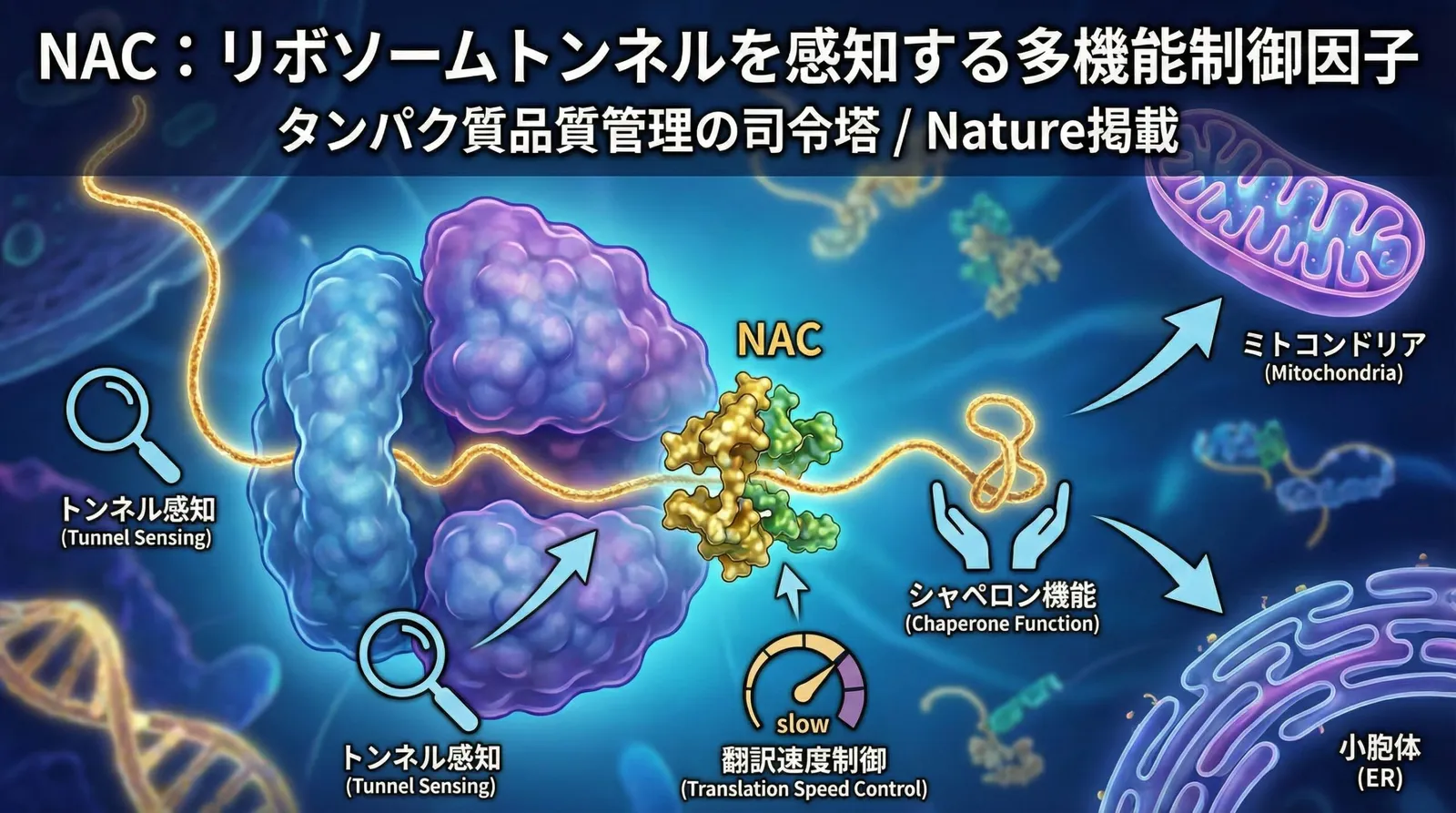
This study reveals that the nascent polypeptide-associated complex (NAC) is a multifaceted regulator that coordinates translation elongation, co-translational folding, and organelle targeting during protein biosynthesis. Ribosome profiling using the nematode C. elegans showed that NAC interacts with nascent polypeptides both inside and outside the ribosomal exit tunnel, and that through sequence-specific binding and control of translation speed it contributes to protein quality control.
Background
Within cells, proteins are synthesized on ribosomes, but this process is complex and requires elongation of translation, folding, and transport to the appropriate location. The nascent polypeptide-associated complex (NAC) is known as a chaperone that binds to ribosomes and assists these processes. However, many aspects remained unclear, including NAC’s specific mechanism of action and how it accommodates such a diverse range of proteins. In particular, what role NAC plays within the ribosomal tunnel, and how this affects the fate of proteins, were important unresolved questions.
Lab & Authors
The laboratory of the corresponding or final author of this study has conducted research on protein synthesis and quality control for many years, focusing in particular on the interaction between ribosomes and chaperones. They seek to understand at the molecular level how proteins are folded and transported to the appropriate location within the cell during the process of synthesis on the ribosome. In their previous research, they have elucidated the roles of various chaperones and clarified mechanisms for preventing protein aggregation. This study, which discovered a new function of NAC—an important chaperone—can be regarded as the culmination of their many years of research.
Key Findings – Molecular, Cellular, and Tissue Levels
The most important discovery in this study is that NAC has the ability to sense short nascent polypeptides within the ribosomal tunnel and adjust the speed of translation. This suggests that NAC is involved in protein quality control not merely as a chaperone, but from the early stages of translation.
By way of analogy, NAC is like a quality control expert on a protein manufacturing line. When proteins are made on the manufacturing line that is the ribosome, NAC detects defective products (aggregation-prone proteins) from the early stages and adjusts the manufacturing speed, thereby preventing the occurrence of defective products. Furthermore, NAC also plays the role of directing the delivery route so that completed proteins are transported to the appropriate location.
Specifically, the following points were clarified.
- NAC binds to nascent polypeptides in a sequence-specific manner: Ribosome profiling using the nematode C. elegans showed that NAC preferentially binds to nascent polypeptides having specific sequences. This suggests that NAC recognizes the sequence of a protein and exerts different actions depending on its characteristics.
- NAC slows the speed of translation: It was observed that when NAC binds to the ribosome, the speed of translation temporarily slows. This is thought to be a strategy by which NAC provides the time needed for protein folding and prevents aggregation.
- NAC assists transport to mitochondria and the ER: NAC was shown to recognize the signal sequences of proteins transported to the mitochondria and the ER, and to assist transport to these organelles. This suggests that NAC is also involved in protein transport and plays a role in placing proteins at the appropriate location within the cell.
Discussion / Implications
Anti-aging
Protein quality control is closely linked to cellular aging. With age, the cell’s protein quality control system declines, protein aggregation increases, and cellular function deteriorates. Because NAC plays an important role in protein quality control, strengthening NAC’s function may make it possible to prevent the protein aggregation that accompanies aging and to maintain cellular health. The development of NAC-targeted anti-aging strategies is likely to become an important research topic going forward.
Regenerative Medicine (MSC / EV)
Mesenchymal stem cells (MSC) and extracellular vesicles (EV) are attracting attention in the field of regenerative medicine. These cells and vesicles release various factors that promote cell survival and assist tissue repair. Because NAC is involved in protein quality control, NAC may also be among the factors released by MSC and EV. By introducing NAC into MSC or EV, it may be possible to strengthen protein quality control and enhance the effectiveness of regenerative medicine.
Neuro-organ Crosstalk
The brain and the organs influence one another, and this interaction is called neuro-organ crosstalk. In recent years, it has become clear that this crosstalk is involved in the onset of various diseases. Because NAC is involved in protein quality control, a decline in NAC function in the brain may cause protein aggregation in the organs, leading to a deterioration of organ function. NAC-targeted therapies may prove useful in treating diseases mediated by neuro-organ crosstalk.
Future Prospects
This study discovered a new function of NAC and demonstrated the importance of NAC in protein quality control. In future research, the following points are likely to be important.
- Elucidating NAC’s mechanism of action: It will be necessary to elucidate in detail the molecular mechanism by which NAC senses nascent polypeptides within the ribosomal tunnel and adjusts the speed of translation.
- Developing NAC-targeted therapies: Strengthening NAC’s function may make it possible to prevent protein aggregation and maintain cellular health. Application to NAC-targeted anti-aging strategies and regenerative medicine is anticipated.
- Elucidating the relationship between NAC and disease: A decline in NAC function may be involved in the onset of various diseases. Elucidating the relationship between NAC and disease may lead to the development of new therapies.
Conclusion
This study revealed that the nascent polypeptide-associated complex (NAC) is a multifaceted regulator of nascent protein chains that senses the ribosomal tunnel and controls chaperone function. NAC is thought to be involved in protein quality control from the early stages of translation, to prevent protein aggregation, and to play an important role in maintaining cellular health. Application to NAC-targeted anti-aging strategies and regenerative medicine is anticipated, and the further development of this research is drawing attention.