Journal Information
- Article link: 10.1038/s41587-025-02890-8
- Journal: Nature Biotechnology
- Impact Factor: approximately 54 (2024 estimate)
- About the journal: Nature Biotechnology is one of the top journals in the field of biotechnology, published by Nature Research. It publishes high-quality papers on innovative technologies, translational research, and the commercial application of biological discoveries. It is especially noted for cutting-edge research findings across a broad range of fields, including medicine, pharmaceuticals, agriculture, and environmental science.
Summary
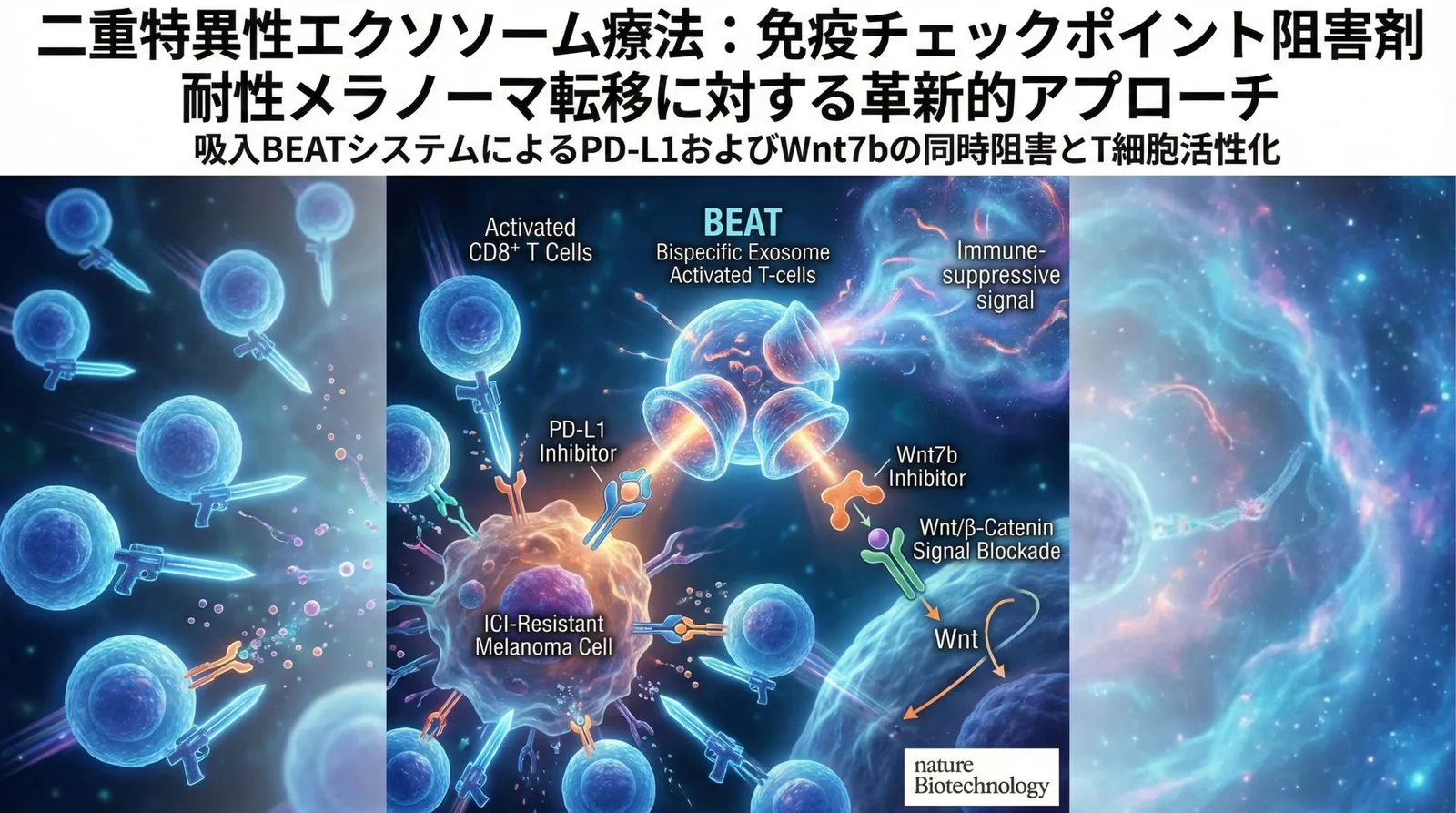
This study focuses on developing an inhalable bispecific exosome-activated T cell (BEAT) system aimed at treating metastatic melanoma that exhibits resistance to immune checkpoint inhibitors (ICIs). This system targets the tumor microenvironment (TME) and, by simultaneously presenting ligands for PD-1 and FZD8, blocks Wnt/β-catenin signaling, a major mechanism of ICI resistance. BEAT effectively inhibits PD-L1 and Wnt7b and exerts a potent antitumor effect by recruiting and activating CD8⁺ T cells in the TME. In particular, inhaled BEAT showed superior therapeutic efficacy compared with bispecific antibody therapy targeting PD-L1 and Wnt7b, suggesting potential application to various ICI-resistant cancers.
Background
In recent years, immune checkpoint inhibitors (ICIs) have shown remarkable therapeutic efficacy across various cancer types, yet many patients still exhibit resistance to ICIs. Melanoma, particularly metastatic melanoma, is one of the cancers in which ICI therapy is less likely to be effective. One cause is the immunosuppressive state of the tumor microenvironment (TME). The TME contains numerous factors that impede the infiltration of immune cells and molecules that suppress immune cell activity, hindering the effect of ICIs. Among these, activation of the Wnt/β-catenin signaling pathway is closely associated with immunosuppression in the TME and is considered one of the important mechanisms of ICI resistance. Wnt signaling is a crucial signaling pathway involved in cell proliferation, differentiation, and survival, affecting not only cancer cells but also other cells within the TME. When this signaling pathway is activated, it is known to impede immune cell infiltration and suppress the tumor immune response.
Therefore, to enhance the effect of ICIs, it is necessary to improve the immunosuppressive state of the TME and target immunosuppressive pathways such as Wnt signaling. In this study, to address this challenge, the team developed a novel therapeutic strategy using exosomes. Exosomes are nanosized vesicles that play a role in transmitting information between cells and are expected to be applied as drug delivery systems. By simultaneously presenting ligands for PD-1 and FZD8 on the surface of exosomes, the research team aimed to simultaneously inhibit PD-L1 and Wnt7b and effectively improve the immunosuppressive state of the TME.
Key Findings (Molecular, Cellular, and Tissue Levels)
The main findings of this study are as follows.
- Design and fabrication of the bispecific exosome (BEAT): The research team developed a technique to simultaneously present ligands for PD-1 and FZD8 at a uniform ratio (1:1) on the surface of exosomes using the Alix sorting domain. This enabled the fabrication of BEAT capable of effectively inhibiting PD-L1 and Wnt7b. This technique is like raising two important flags, PD-1 and FZD8, on a small ship called an exosome. Each flag sends a different message to immune cells and tumor cells, activating the immune response and suppressing tumor growth.
- Recruitment and activation of CD8⁺ T cells by BEAT: In in vitro and in vivo experiments, BEAT was shown to effectively recruit and activate CD8⁺ T cells in the tumor microenvironment (TME). The activated CD8⁺ T cells directly attack tumor cells and suppress tumor growth. This is like BEAT summoning soldiers called T cells to the battlefield, arming them, and having them attack the enemy (tumor cells).
- Antitumor effect in an ICI-resistant melanoma mouse model: In an ICI-resistant melanoma mouse model, inhaled BEAT showed a superior antitumor effect compared with bispecific antibody therapy targeting PD-L1 and Wnt7b. BEAT suppressed tumor growth and prolonged survival. This suggests that BEAT is promising as a new therapeutic strategy for ICI-resistant melanoma. For example, whereas conventional therapies merely slow tumor growth, BEAT is expected to actively attack the tumor and increase the possibility of a cure.
- Inhibition of Wnt/β-catenin signaling: BEAT was shown to effectively inhibit Wnt/β-catenin signaling in tumor cells. Inhibition of Wnt/β-catenin signaling improves the immunosuppressive state of the tumor microenvironment and promotes immune cell infiltration. This is like BEAT breaking down the tumor’s defensive wall, making it easier for immune cells to invade the tumor.
Discussion / Implications
Anti-aging
Exosomes play an important role in mediating communication between cells and are thought to be deeply involved in the aging process. The BEAT developed in this study exerts its antitumor effect by activating the immune response and improving the tumor microenvironment, but through similar mechanisms it may also be applicable to the treatment of various diseases associated with aging. For example, against immunosenescence—the decline of immune function with aging—activating immune cells using BEAT may promote the recovery of immune function and reduce the risk of infectious and autoimmune diseases.
Regenerative Medicine (MSC / EV)
Exosomes (EVs) secreted by mesenchymal stem cells (MSCs) are known to have effects that promote tissue repair and regeneration. The BEAT developed in this study may exert an even more powerful regenerative medicine effect when combined with MSC-EV. For example, administering MSC-EV to damaged tissue and then administering BEAT may be expected to activate the immune response and promote tissue repair. In particular, in nervous system regeneration, BEAT may enable more effective treatment by suppressing neuroinflammation and promoting the survival of nerve cells.
Neuro–Organ Interaction
In recent years, it has become clear that there is a close interaction between the nervous system and other organs. For example, bidirectional communication exists between the brain and the gut, and it is known that the gut microbiota affects brain function. The BEAT developed in this study may affect neuro–organ interaction via the immune system. For example, BEAT administered to the lungs may activate the immune response of the nervous system and affect brain function. Elucidating this mechanism may lead to the development of new therapeutic strategies for neurological diseases.
Future Prospects
This study suggests the possibility of a new therapeutic strategy for immune checkpoint inhibitor-resistant melanoma, and further development is anticipated. Future research will need to focus on the following points.
- Clinical application of BEAT: This study has only demonstrated efficacy in a mouse model. Toward the clinical application of BEAT, various factors—including safety, efficacy, the method of administration, and the dosage—need to be examined. In particular, the safety of inhalation administration requires careful evaluation.
- Improving the target specificity of BEAT: In this study, PD-L1 and Wnt7b were inhibited by loading ligands for PD-1 and FZD8 onto exosomes, but to further enhance target specificity, it is necessary to combine other ligands or antibodies. For example, targeting molecules specifically expressed on tumor cells may be expected to reduce side effects and enhance the therapeutic effect.
- Elucidation of the mechanism of action of BEAT: In this study, BEAT was shown to exert its antitumor effect by activating CD8⁺ T cells and inhibiting Wnt/β-catenin signaling, but its detailed mechanism has not yet been clarified. Elucidating the mechanism of action of BEAT in detail may lead to the development of more effective therapeutic strategies.
- Application to other cancer types: In this study, the efficacy of BEAT against melanoma was demonstrated, but application to other cancer types, particularly those exhibiting immune checkpoint inhibitor resistance, is also anticipated. For example, the efficacy of BEAT needs to be examined in various cancer types, such as lung cancer, kidney cancer, and bladder cancer.
Conclusion
In this study, a bispecific exosome-activated T cell (BEAT) system was developed as a new therapeutic strategy for immune checkpoint inhibitor-resistant melanoma. BEAT simultaneously inhibits PD-L1 and Wnt7b and activates CD8⁺ T cells, thereby exerting a potent antitumor effect. This study may contribute to the development of new therapies for cancer patients who exhibit immune checkpoint inhibitor resistance. However, toward clinical application, further examination of safety, efficacy, the mechanism of action, and other aspects is needed. We hope that research on BEAT will progress further and bring hope to many cancer patients.