Journal Information
- Article link: https://doi.org/10.1002/jev2.70220
- Journal: Journal of Extracellular Vesicles
- Impact Factor: approximately 25 (estimated)
- About the journal: The Journal of Extracellular Vesicles (JEV) is one of the most authoritative journals in the field, publishing cutting-edge findings in extracellular vesicle (EV) research. It covers a wide range of topics, from the basic biology of EVs to their clinical applications.
Summary
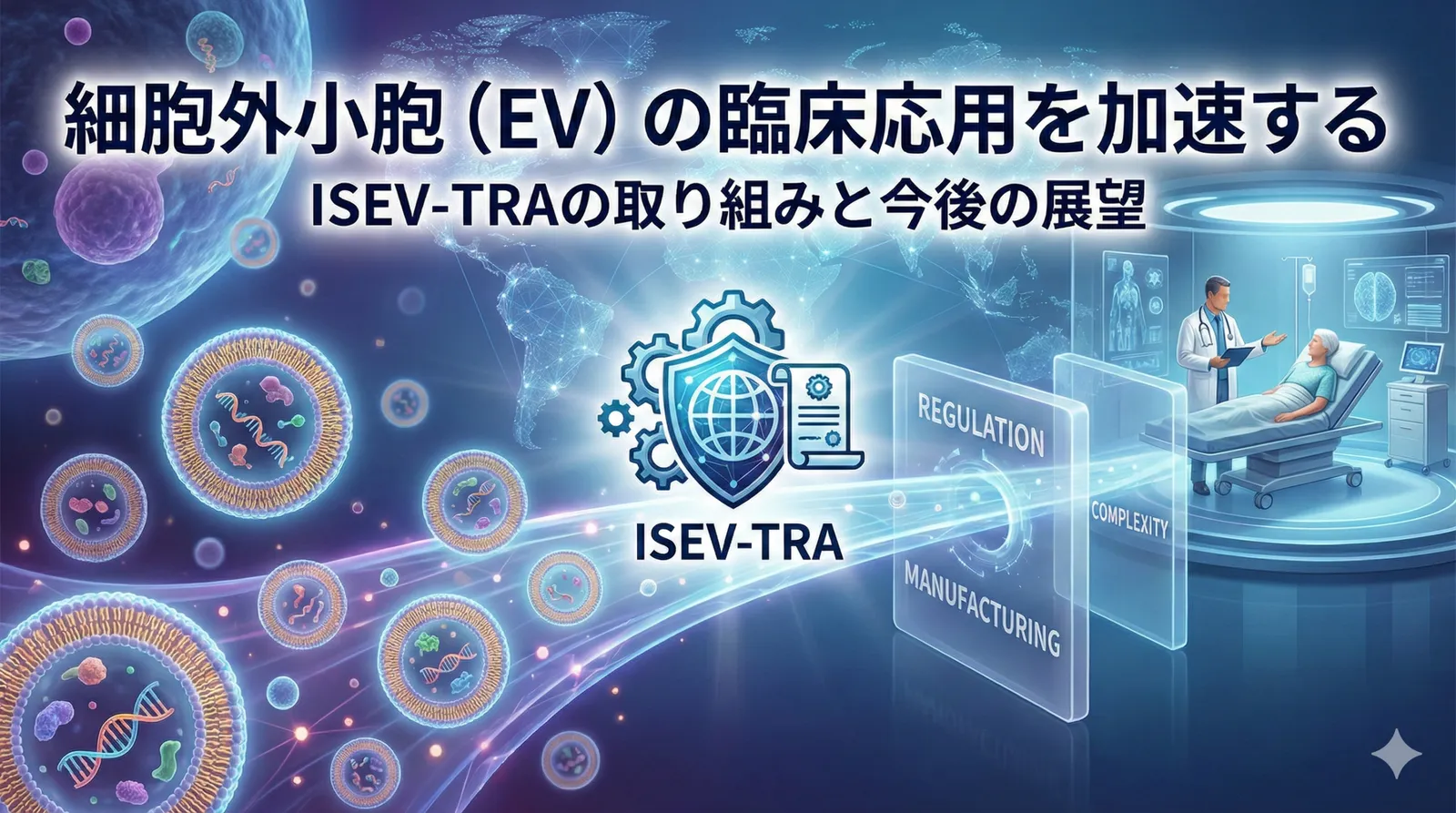
Extracellular vesicles (EVs) are key mediators of intercellular communication and hold promise for applications across a broad range of fields, including biomedicine, veterinary medicine, cosmetics, agriculture, and the environment. However, translating EV-based research findings into practical and commercially viable products faces many barriers, including scientific complexity, regulatory uncertainty, and manufacturing challenges.
This paper focuses on the work of the Translation, Regulation and Advocacy Committee (ISEV-TRA) of the International Society for Extracellular Vesicles (ISEV), established to address these challenges, and provides a detailed discussion of the current status and challenges in translating EV research into clinical applications, as well as future prospects. ISEV-TRA aims to promote the responsible advancement of EV technologies by fostering cross-disciplinary collaboration, harmonizing quality and regulatory frameworks, and engaging in strategic advocacy to facilitate market entry.
Through targeted initiatives such as hosting workshops and developing translational resources and guidance, ISEV-TRA aims to bridge the gap between research and real-world implementation. By fostering dialogue among academia, industry, investors, and policymakers, ISEV-TRA has established itself as a central driving force in shaping a global roadmap for the translation and commercialization of EVs.
Background
Extracellular vesicles (EVs) are nanosized vesicles enclosed by a lipid bilayer that are secreted by virtually all cells. EVs contain a variety of cell-derived molecules, including proteins, nucleic acids (such as mRNA, miRNA, and DNA), and lipids. Through these molecules, EVs are known to transmit information between cells and to influence physiological functions and disease states.
EV research has advanced rapidly in recent years and holds promise for applications in the diagnosis and treatment of various diseases, including cancer, neurological diseases, cardiovascular diseases, and infectious diseases. In particular, active research is being conducted on using EVs as drug delivery systems and on harnessing the biomarkers contained in EVs for the early detection of disease.
However, many challenges remain in translating EV research into clinical applications. Key challenges include standardizing methods for the isolation and purification of EVs, establishing methods for EV characterization, optimizing EV manufacturing processes, and collaborating with regulatory authorities.
Lab & Authors
This paper was written by the Translation, Regulation and Advocacy Committee (ISEV-TRA) of the International Society for Extracellular Vesicles (ISEV), a group of world-leading experts in the field of extracellular vesicle (EV) research. ISEV-TRA is a committee established to accelerate the clinical translation of EV research, with the participation of experts from various fields, including academia, industry, and regulatory authorities.
ISEV is an international academic body established to advance and disseminate extracellular vesicle research. It conducts a variety of activities, including hosting international conferences on EV research, publishing academic journals, and promoting exchange among researchers.
The members of ISEV-TRA are researchers active at the forefront of EV research, with deep knowledge and experience in the basic biology, clinical application, and regulation of EVs. They are working actively to overcome the challenges in the clinical translation of EV research and to fully realize the potential of EV technologies.
One particularly notable researcher is Dr. Kenneth Witwer, one of the corresponding authors of this paper. Dr. Witwer is an associate professor at the Johns Hopkins University School of Medicine and one of the world’s leading authorities in the study of extracellular vesicles.
Dr. Witwer’s laboratory conducts a broad range of research on the basic biology of EVs, including the molecular composition of EVs, their role in intercellular communication, and their involvement in disease. The lab is also actively engaged in the development of EV-based diagnostics and therapeutics.
Dr. Witwer has published numerous papers, and his research has contributed greatly to the advancement of EV research. He also serves on the board of ISEV and is dedicated to the dissemination and advancement of EV research.
Dr. Witwer’s laboratory conducts cutting-edge research in the field of EV research, and its findings consistently attract attention. The lab’s research philosophy is to fully realize the potential of EV research by pursuing basic research and clinical application in tandem. The lab’s technical strengths lie in its advanced expertise in the isolation and purification, characterization, and molecular analysis of EVs. It also excels in its ability to analyze the physiological functions and pathological roles of EVs using various disease models.
Dr. Witwer is one of the most influential researchers in the field of EV research, and his laboratory is highly regarded worldwide as a driving force in the advancement of EV research.
(Sources consulted: Johns Hopkins University School of Medicine website, PubMed, ResearchGate, ISEV website)
Key Findings (Molecular, Cellular, and Tissue Levels)
This paper is a review article and is not intended to present new findings based on experimental data. Therefore, it does not contain detailed analytical results at the molecular, cellular, or tissue levels, nor validation results from animal models. However, it provides important information on the current status and challenges in the clinical translation of EV research and on the work of ISEV-TRA.
The main findings derived from this review article are summarized below.
1. Barriers to the Clinical Translation of EV Research
The clinical translation of EV research faces the following barriers:
- Scientific complexity: EVs are highly diverse in their origin, composition, and function, making it difficult to accurately characterize EVs and to control their functions.
- Regulatory uncertainty: The development of EV-based products requires approval from regulatory authorities, but regulations concerning EVs have not yet been established. As a result, the product development process is opaque and may be costly and time-consuming.
- Manufacturing challenges: Producing EVs in large quantities and at high quality is technically difficult. Scaling up the manufacturing process is also a major challenge.
To overcome these barriers, technological development related to the standardization, characterization, and manufacturing of EVs is essential. It is also necessary to strengthen collaboration with regulatory authorities and to establish clear regulations concerning EVs.
2. The Work of ISEV-TRA
ISEV-TRA is undertaking the following initiatives to overcome the barriers to the clinical translation of EV research:
- Promoting cross-disciplinary collaboration: ISEV-TRA brings together experts from various fields, including academia, industry, and regulatory authorities, to promote the exchange of information and collaborative research on EV research.
- Harmonizing quality and regulatory frameworks: ISEV-TRA aims to improve the quality of EV research by developing guidelines on the standardization, characterization, and manufacturing of EVs. It also aims to establish clear regulations concerning EVs through dialogue with regulatory authorities.
- Strategic advocacy to facilitate market entry: ISEV-TRA aims to broadly raise public awareness of the importance of EV research and to promote investment in it. It also aims to support the development of EV-based products and to accelerate their entry into the market.
These initiatives by ISEV-TRA play a very important role in accelerating the clinical translation of EV research.
3. Future Outlook for EV Research
EV research is expected to develop further and to be applied in various fields. In particular, applications are anticipated in the following areas:
- Diagnosis: The biomarkers contained in EVs can be harnessed for the early detection of disease. For example, analyzing the EVs secreted by cancer cells may enable the early diagnosis of cancer.
- Therapy: EVs can be used as drug delivery systems or as therapeutic agents in their own right. For example, it may be possible to develop EVs that selectively deliver drugs to specific cells or EVs that activate immune cells.
- Regenerative medicine: EVs can be used to promote cellular regeneration and repair. For example, administering EVs secreted by stem cells is expected to promote tissue regeneration and suppress inflammation.
To realize these applications, further technological development related to EV research and collaboration with regulatory authorities are essential. ISEV-TRA is expected to continue working actively to overcome these challenges and to fully realize the potential of EV research.
An analogy: EVs are like letters between cells. Cells write messages into EVs and send them to other cells to transmit information. ISEV-TRA is working to improve how these letters are written (standardization of EVs) and how they are delivered (targeting of EVs), so that the “letters” that are EVs can be used more effectively.
(Note: This section is written based on the content of the paper and does not contain specific experimental data.)
Discussion / Implications
- Anti-aging: EVs may suppress the aging process by removing harmful molecules secreted by senescent cells or by supplementing anti-aging molecules secreted by young cells. To use EVs as an anti-aging therapy, it is necessary to analyze in detail the effects of EVs on aging and to establish safe and effective methods of administration.
- Regenerative medicine (MSC / EV): EVs secreted by mesenchymal stem cells (MSCs) are expected to promote tissue regeneration and repair. MSC-EVs are thought to promote tissue regeneration by suppressing inflammation, promoting angiogenesis, and enhancing cell survival. To apply MSC-EVs in regenerative medicine, it is necessary to identify the active components of MSC-EVs and to elucidate their mechanisms of action. It is also necessary to optimize the MSC-EV manufacturing process and to provide a stable supply of high-quality MSC-EVs.
- Neuro-organ crosstalk: The brain and other organs are closely linked through the nervous system, and EVs may also play an important role in this linkage. For example, EVs secreted by the brain may regulate the function of the heart or kidneys, and conversely, EVs secreted by the heart or kidneys may regulate brain function. Elucidating the role of EVs in neuro-organ crosstalk may contribute to understanding the pathology of systemic diseases and to developing treatments.
Future Prospects
EV research is expected to develop further and to be applied in various fields. In particular, applications are anticipated in the following areas:
- Personalized medicine: By analyzing the biomarkers contained in EVs, it is possible to predict a patient’s disease status and treatment response and to provide personalized treatment.
- Exosome drug discovery: By developing drugs that control the functions of EVs, it is possible to provide new treatments. For example, it may be possible to develop EVs that selectively deliver drugs to specific cells or EVs that activate immune cells.
- Extracellular vesicle engineering: By modifying the functions of EVs, it is possible to provide more effective treatments. For example, it may be possible to modify EVs to express specific proteins or to bind to specific cells.
Conclusion
Extracellular vesicles (EVs) are key mediators of intercellular communication and hold promise for applications across a broad range of fields, including biomedicine, veterinary medicine, cosmetics, agriculture, and the environment. However, translating EV-based research findings into practical and commercially viable products faces many barriers, including scientific complexity, regulatory uncertainty, and manufacturing challenges.
To address these challenges, the International Society for Extracellular Vesicles (ISEV) established the Translation, Regulation and Advocacy Committee (ISEV-TRA). ISEV-TRA aims to promote the responsible advancement of EV technologies by fostering cross-disciplinary collaboration, harmonizing quality and regulatory frameworks, and engaging in strategic advocacy to facilitate market entry.
The work of ISEV-TRA plays a very important role in accelerating the clinical translation of EV research. EV research is expected to develop further and to be applied in various fields. ISEV-TRA is expected to continue working actively to overcome these challenges and to fully realize the potential of EV research.