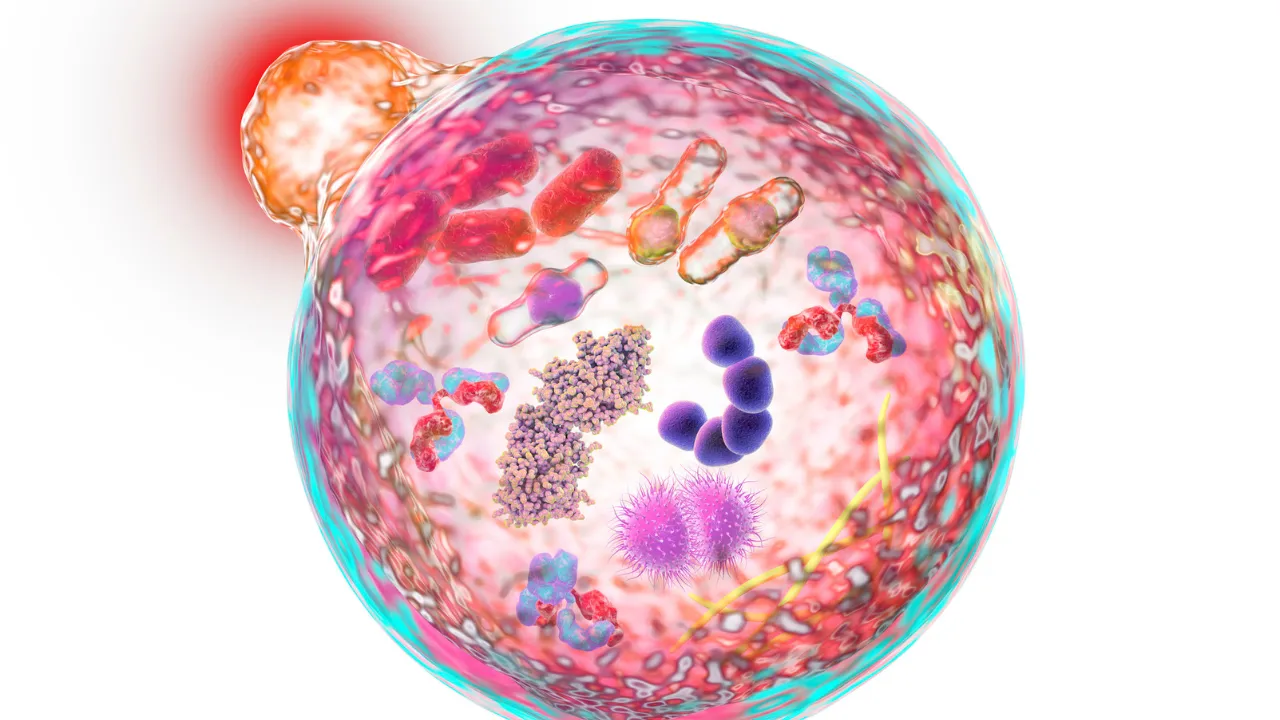
Autophagy (self-eating) is the process by which cells degrade and recycle damaged or dysfunctional cellular components and unwanted proteins. Autophagy supports cellular homeostasis (the maintenance of a stable state) and is associated with disease and aging. This process is highly complex and involves many different molecules and pathways. The following provides a brief overview of the main classifications of autophagy and their associated molecular mechanisms.
The Main Forms of Autophagy:
Macroautophagy
- Initiation: When autophagy begins, the cell forms a small membrane structure called the phagophore or isolation membrane. This process involves the ULK1 complex and the PI3K complex.
- Nucleation and Elongation: The phagophore then expands and forms a double-membrane structure called the autophagosome. This process requires the involvement of ATG proteins and LC3-II.
- Fusion: The autophagosome then fuses with the lysosome to form an autolysosome. This involves SNARE proteins, LAMP1/2, and other molecules.
- Degradation and recycling: Hydrolytic enzymes within the lysosome break down the engulfed material, and the degraded material is reused within the cell.
Microautophagy
- In this form of autophagy, the lysosomal membrane directly engulfs the substrate. The lysosomal membrane has the ability to directly take up proteins and organelles.
Chaperone-Mediated Autophagy (CMA)
- This is a process in which cytosolic proteins are degraded via the ubiquitin-proteasome pathway. It is related to autophagy, but the lysosome is not involved; instead, the proteasome plays the central role.
These three pathways are the main ways in which cells efficiently process and recycle unwanted components, and they are essential for maintaining healthy cellular function. These pathways are also involved in the cellular stress response, aging, and disease progression. Because the various types of autophagy proceed through specific molecular mechanisms and pathways, researchers are working to develop new therapies that target these processes.
Molecular Mechanisms Involved in Autophagy
1. Initiation (induction phase):
a. Nutrient sensing and upstream signaling
- The nutrient status of the cell is monitored by mTOR (mammalian target of rapamycin) complex 1 (mTORC1). Under nutrient-rich conditions, mTORC1 suppresses autophagy, whereas under nutrient deprivation mTORC1 is inactivated and autophagy is activated.
- AMP-activated protein kinase (AMPK) can also sense the low-energy state within the cell and induce autophagy by suppressing mTORC1.
b. Formation of the ULK1 complex
- The initiation process is regulated by the ULK1 complex. This complex is composed of ULK1/2 (serine/threonine protein kinases), ATG13, FIP200, and ATG101.
- Following the inactivation of mTORC1, the ULK1 complex is activated, translocates to the site of phagophore (early autophagic vesicle) formation, and initiates nucleation.
2. Nucleation and elongation (formation of the phagophore):
The “Nucleation” phase in autophagy is an early stage of the autophagic process and refers to the point at which the formation of the autophagosome (a double-membrane structure) begins.
Activation of the PI3K complex:
The nucleation phase is associated with the activation of the PI3K complex (class III phosphatidylinositol 3-kinase). This complex notably includes VPS34, Beclin-1, VPS15, and ATG14L.
Formation of the phagophore:
Nucleation is involved in the formation of the early autophagosomal structure called the phagophore. This structure ultimately elongates to form the autophagosome.
Production of PI3P:
The PI3K complex produces phosphatidylinositol 3-phosphate (PI3P), a signaling lipid that is important for promoting the growth and elongation of the phagophore.
Recruitment of ATG proteins:
The production of PI3P functions as a signal that recruits other autophagy-related proteins (ATG proteins) to the site of phagophore formation.
ATG proteins and LC3 lipidation
- ATG proteins are important in elongation. Two ubiquitin-like conjugation systems are involved: the ATG12-ATG5-ATG16L1 complex and the LC3-II (Microtubule-associated protein 1A/1B-light chain 3) system.
- The LC3 protein is processed to LC3-I and then lipidated to LC3-II, which promotes membrane elongation. This lipidation involves the ATG7 and ATG3 enzymes and is promoted by the ATG12-ATG5-ATG16L1 complex.
3. Formation of the autophagosome:
a. Cargo recognition Cargo Recognition
- Specific cargo (damaged organelles, proteins) is recognized by autophagy receptors (such as p62/SQSTM1), and binding to LC3-II on the autophagosome membrane promotes the sequestration of the cargo.
b. Membrane closure
- The elongating membrane ultimately closes to form a double-membrane vesicle called the autophagosome, engulfing the targeted cargo.
4. Fusion with the lysosome (formation of the autolysosome):
a. Maturation of the autophagosome
- The mature autophagosome moves along the microtubule network toward the lysosome through a process regulated by molecular motors and associated proteins.
b. Fusion with the lysosome
- Fusion with the lysosome promotes membrane fusion involving SNARE proteins, the HOPS complex, and other molecules, forming the autolysosome.
5. Degradation and recycling:
a. Degradation of the contents
- Within the autolysosome, the acidic environment and lysosomal hydrolytic enzymes break down the engulfed material into basic molecules (amino acids, fatty acids, etc.).
b. Recycling of nutrients
- The degraded components are transported back into the cytoplasm and reused, supporting cellular metabolism and biosynthesis.
This overview provides more detailed insight into the molecular mechanisms that drive macroautophagy, highlighting the key complexes, molecules, and processes involved at each stage. This is a coordinated regulatory process essential for maintaining cellular homeostasis and health.