Explanation of terms
Endoplasmic reticulum
The endoplasmic reticulum (ER) is part of the membrane system inside the cell and is responsible for fundamental cellular functions. It spreads out so as to surround the cell nucleus, and its structure forms an extensive and complex network. The endoplasmic reticulum can be broadly divided into two types: rough endoplasmic reticulum and smooth endoplasmic reticulum.
The rough endoplasmic reticulum (Rough Endoplasmic Reticulum, RER) gets its name from its rough appearance, which is due to ribosomes—the structures that synthesize proteins—being attached closely to its surface. The main function of the RER is to fold and modify newly synthesized proteins and to send them to the appropriate places within the cell.
The smooth endoplasmic reticulum (Smooth Endoplasmic Reticulum, SER), on the other hand, has no ribosomes and has a smooth appearance. The main functions of the SER are the synthesis of lipids and steroids, the metabolism of carbohydrates, and the detoxification of toxins.
The endoplasmic reticulum plays a central role in protein synthesis and lipid metabolism, and through these processes it contributes to maintaining the life of the cell. The endoplasmic reticulum also functions as part of the cellular stress response: when proteins are not folded correctly, it has mechanisms to detect and correct these abnormalities. This stress response from the endoplasmic reticulum plays an important role in maintaining the balance between cell survival and cell death.
Ribosomes
The ribosome is a tiny machine present inside the cells of living organisms, and it plays the role of producing proteins—that is, protein synthesis (translation). It plays an important role in the basic process of expressing an organism’s genetic information, in which the information of a gene is transcribed from DNA into RNA, and that RNA is read by the ribosome and translated into protein.
The ribosome is composed of two subunits made of ribosomal RNA (rRNA) and ribosomal proteins: a large subunit and a small subunit. The ribosome carries out its function when these two subunits combine.
The process by which the ribosome carries out protein synthesis is as follows:
- Messenger RNA (mRNA) binds to the small subunit of the ribosome.
- After a specific sequence on the mRNA (the start codon) is recognized, the large subunit binds and a complete ribosome is formed.
- As the ribosome reads along the mRNA, it translates each codon (three nucleotides on the mRNA) into the corresponding amino acid. This translation work is carried out by a special RNA molecule called transfer RNA (tRNA).
- When translation is finished, the newly synthesized protein is released from the ribosome and goes on to carry out its subsequent biological function.
Ribosomes are present in various locations within the cell: some float freely in the cytoplasm, while others are attached to the surface of the rough endoplasmic reticulum or mitochondria. Their location differs depending on the type of protein the ribosome synthesizes and that protein’s subsequent fate.
Golgi apparatus
The Golgi apparatus is part of the cell’s membrane system and is the main site where newly synthesized proteins and lipids are modified, sorted (classified), and packaged. This structure was named after the Italian scientist Camillo Golgi.
The Golgi apparatus is made up of a series of flat, sac-like structures (Golgi vesicles) that stack on top of one another to form the Golgi apparatus as a whole. The Golgi apparatus has two main faces: the cis face (forming face) and the trans face (maturing face). The cis face is the side closer to the endoplasmic reticulum and serves as the entrance through which newly synthesized proteins and lipids are sent from the endoplasmic reticulum to the Golgi apparatus. The trans face serves as the exit through which substances are sent from the Golgi apparatus to other parts of the cell.
The main tasks carried out in the Golgi apparatus are as follows:
- Modification: as proteins and lipids pass through the Golgi apparatus, various chemical modifications (for example, the addition or correction of sugar chains) are carried out. This regulates the function of the proteins and lipids.
- Sorting: the modified proteins and lipids then go through a process that determines where they should be sent. These molecules are sent to other parts of the cell (for example, lysosomes or mitochondria), to the cell surface, or to outside the cell.
- Packaging: the proteins and lipids to be sent out are wrapped in a membrane called a vesicle, which becomes the means of transport for the proteins and lipids.
Through functions such as these, the Golgi apparatus controls the cell’s protein trafficking and plays an important role in maintaining cellular function.
Biogenesis of EVs in the endoplasmic reticulum and Golgi apparatus
Exosomes, or extracellular vesicles (EV), are small, bubble-like structures that carry information inside the cell, and they perform many important functions in the body. They help cell-to-cell communication and regulate growth, development, immune responses, disease progression, and more in an organism. Below, we explain in detail the two main cellular structures involved in the production of exosomes—namely, the endoplasmic reticulum and the Golgi apparatus.
First, exosome production is carried out by a complex pathway inside the cell that includes the endoplasmic reticulum and the Golgi apparatus. The endoplasmic reticulum plays the role of folding newly made proteins within the cell, modifying them, and sending them to the appropriate place. In particular, proteins from the endoplasmic reticulum are sent to the Golgi apparatus, where they are further modified. The Golgi apparatus functions as the place where, within the cell, proteins are ultimately modified and sent inside or outside the cell.
Exosome production begins in the endoplasmic reticulum. Proteins and lipoproteins secreted from the endoplasmic reticulum leave the endoplasmic reticulum and move to the Golgi apparatus. During this process, these proteins and lipoproteins are taken up into an intracellular vesicular structure called the endosome. The endosome plays the role of carrying substances to other sites within the cell.
When the endosome matures, it becomes a structure called a multivesicular body (MVB). Inside the MVB, numerous internal vesicles—that is, the precursors of exosomes—are formed. These precursors contain various substances to be carried from the cell to the outside, such as proteins, lipoproteins, and RNA.
The MVB is then sent to the Golgi apparatus. In the Golgi apparatus, the exosome precursors from the MVB undergo further modification and finally mature into exosomes. In the Golgi apparatus, important modifications that affect the shape and function of the exosome are carried out. These include protein modifications such as the addition of sugar chains and phosphorylation.
When the exosome matures in the Golgi apparatus, it moves toward the cell membrane and fuses with the cell membrane. As a result, the exosome is released outside the cell. This process is called exocytosis and is a major means by which the cell shares information with the external environment.
The production and release of exosomes is an important mechanism by which the cell interacts with its environment, and at the same time it may open new possibilities in the diagnosis and treatment of disease. For example, it is known that exosomes are used by cancer cells to carry signals that help their growth and spread. Therefore, by understanding the production and function of exosomes, we should be able to understand these disease states better and find ways to treat them effectively.
Understanding the roles of the endoplasmic reticulum and the Golgi apparatus is essential for understanding the production and function of exosomes. These structures provide the fundamental machinery that ensures exosomes are properly formed, modified, and released. For this reason, research on exosomes needs to focus on these cellular structures and the roles they play.
As described above, the production of exosomes involves a complex process that passes through the endoplasmic reticulum and the Golgi apparatus. These cellular structures, through a series of processes such as protein folding, modification, and transport, help the formation and release of exosomes. Research on exosomes is still developing, and it is opening new avenues for elucidating how these tiny, bubble-like structures influence the life activities of organisms and how they are involved in the onset and progression of disease.
Inside the exosome are signaling substances. These include RNA, DNA, proteins, and more. These molecules are used in cell-to-cell communication and play a role in regulating the behavior and function of cells. Exosomes are also thought to be involved in transmitting information from the external environment to the cell.
When is microRNA taken up into the exosome?
The microRNA (miRNA) contained inside the exosome is taken up at an early stage of the exosome production process within the cell. Specifically, during the process in which the endosome that becomes the precursor of the exosome is formed, miRNA in the cytoplasm is taken up into the endosome.
The specific mechanism by which miRNA in the cytoplasm is taken up into the endosome has not yet been fully elucidated. However, several studies have suggested some possibilities.
- RNA-binding proteins (RBPs): specific RNA-binding proteins may bind to miRNA and take it up into the endosome. These proteins bind to miRNA and play the role of helping its uptake into the endosome.
- The human protein AGO2: the human protein AGO2 is thought to play a role in taking up miRNA into the endosome. AGO2 may bind to miRNA and help its uptake into the endosome.
- The ESCRT (Endosomal Sorting Complex Required for Transport) complex: this complex is involved in the maturation of the endosome and the formation of the exosome. How it is involved in the uptake of miRNA into the endosome is not yet clear, but an association has been suggested in some studies.
All of these mechanisms indicate possibilities for how miRNA within the cell is taken up into the endosome, but much of the detailed process and the role of each remains unelucidated. Research on the relationship between exosomes and miRNA is still ongoing, and it is hoped that more detailed mechanisms will be revealed in the future.
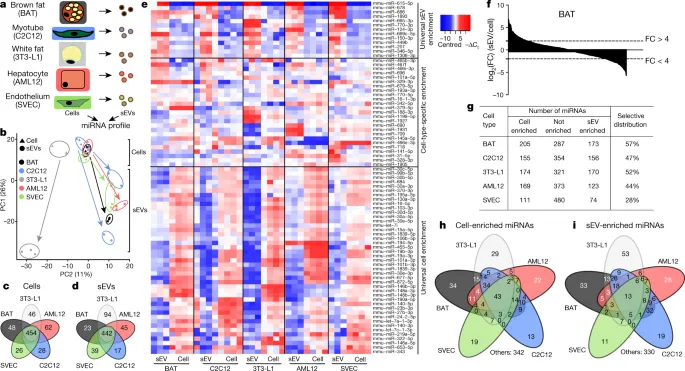
An interesting paper was reported in 2022. In the near future, I would like to summarize its contents.
MicroRNA sequence codes for small extracellular vesicle release and cellular retention - Nature
The miRNA taken up into the endosome is enclosed in the vesicles inside the MVB (intraluminal vesicles) during the process in which the endosome matures and changes into a multivesicular body (MVB). When these vesicles finally become exosomes and are released outside the cell, the miRNA is released together with them.
Note that which miRNA is taken up into the exosome is not random; it is known that specific miRNAs are selectively taken up into exosomes. The mechanism of this selectivity has not been fully elucidated, but several factors (for example, specific RNA-binding proteins) are thought to be involved.
Therefore, miRNA is taken up into the exosome at the endosome formation stage, and through the subsequent maturation and release process of the exosome, it is confined within the exosome and carried outside the cell.
The mechanisms related to exosome production need to be deeply understood in order to achieve the therapeutic application of exosomes. However, since there are still many unclear points, further research is required. With regard to this field, I intend to keep catching up at all times.