Collateral-based selection for endovascular treatment of acute ischaemic stroke in the late window (MR CLEAN-LATE): 2-year follow-up of a phase 3, multicentre, open-label, randomised controlled trial in the Netherlands
Title (English)
Collateral-based selection for endovascular treatment of acute ischaemic stroke in the late window (MR CLEAN-LATE): 2-year follow-up of a phase 3, multicentre, open-label, randomised controlled trial in the Netherlands
Title (Japanese)
急性虚血性脳卒中の遅延窓における血管内治療のための側副血流ベースの選択(MR CLEAN-LATE):オランダにおける第3相、多施設、非盲検、無作為化対照試験の2年間の追跡調査
Journal name and year of publication
The Lancet Neurology, September 2024 issue
First and last authors
First author: Ilse Huijberts
Last author: Robert J van Oostenbrugge
First affiliation
Department of Radiology and Nuclear Medicine, Maastricht University Medical Center+, Maastricht, Netherlands
Abstract
The MR CLEAN-LATE trial demonstrated the safety and efficacy of endovascular treatment in the late window of 6–24 hours after onset, in patients with collateral flow confirmed on CT angiography. This study aimed to evaluate clinical outcomes over the 2 years following randomisation. The trial was conducted at 18 central nervous system disease treatment centres in the Netherlands. Patients were randomly allocated to an endovascular treatment group and a best medical treatment group. After 2 years of follow-up, the endovascular treatment group had better functional outcomes and lower all-cause mortality.
Background
In patients with acute ischaemic stroke, the long-term effects of endovascular treatment in the late window (6–24 hours after onset) were unclear. This study performed a 2-year follow-up to evaluate the clinical outcomes in patients selected on the basis of collateral flow on CT angiography.
Methods
MR CLEAN-LATE is a phase 3, multicentre, open-label, randomised controlled trial conducted at 18 centres in the Netherlands. Study participants were patients with acute ischaemic stroke aged 18 years or older who could potentially undergo endovascular treatment within 6–24 hours after onset. Patients were randomly allocated 1:1 to either an endovascular treatment group or a best medical treatment group.
Results
Patients in the endovascular treatment group had an mRS score of 4 (IQR 2–6) at 2 years, versus 6 (2–6) in the control group, indicating better functional outcomes in the endovascular treatment group. All-cause mortality was 34% in the endovascular treatment group and 41% in the control group.
Discussion
Endovascular treatment in the late window produced favourable functional outcomes over 2 years in patients with confirmed collateral flow. These results are important for the development of health policy and for clinical decision-making.
Novelty
This is the first study to demonstrate the 2-year efficacy of endovascular treatment in the late window in patients selected on the basis of collateral flow.
Limitations
Limitations of this study include the impact of the COVID-19 pandemic and the substantial loss to follow-up in the control group.
Potential applications
The results of this study may contribute to improvements in health policy and clinical decision-making.
What is the specific method for assessing collateral flow on CT angiography?
The method for assessing collateral flow on CT angiography is as follows.
Assessment criteria
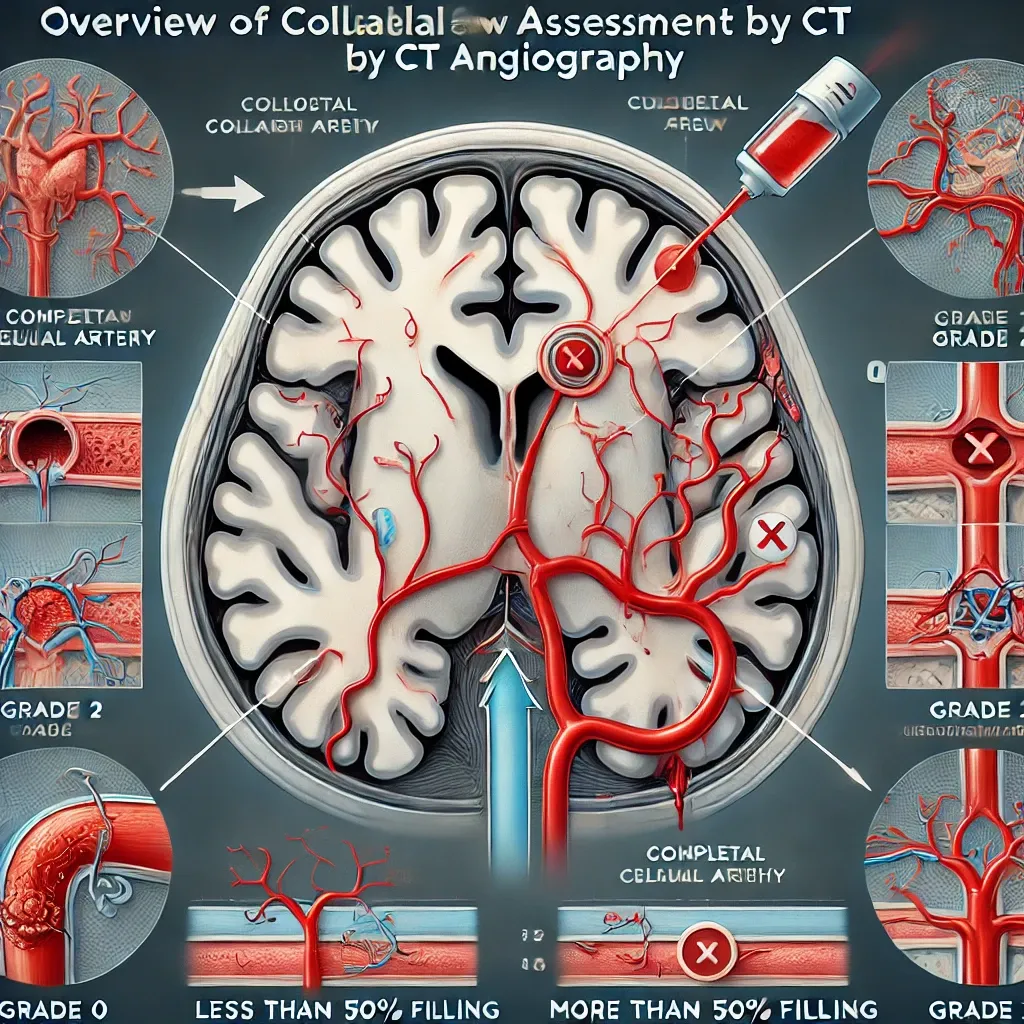
The assessment of collateral flow is a method that uses CT angiography images to quantify the degree of collateral flow in the middle cerebral artery territory affected by ischaemic stroke. In this study, the following criteria are used to assess collateral flow:
- Grade 0: No collateral flow is seen at all.
- Grade 1: Collateral flow is seen in 50% or less of the affected area, but not complete.
- Grade 2: Collateral flow is seen in more than 50% of the affected area, but not complete.
- Grade 3: Complete collateral flow is seen throughout the affected area.
Implementation method
On the images obtained by CT angiography, the extent of collateral flow present is observed and classified according to the grades above. This assessment uses CT angiography images and is based on the degree of filling of the collateral vessels that supply blood to the ischaemic area.
This assessment is used to select patients eligible for endovascular treatment and to help predict subsequent treatment efficacy.
Which parameters are used for visualisation?
When assessing collateral flow on CT angiography, visualisation is performed based on the following parameters.
- Vessel filling: The assessment of collateral flow is performed by observing the degree of filling of the collateral vessels relative to the major vessel occluded by the ischaemic stroke. This indicates how much blood is supplied to the affected area through the collateral vessels.
- Time delay (time-to-peak: TTP): The time from injection of the contrast agent into the vessel until the collateral flow reaches the ischaemic area is measured. A shorter TTP indicates that the collateral flow is functioning effectively.
- Flow velocity and volume (contrast intensity): The extent to which the intensity of the contrast agent (i.e. the CT value) is maintained as it passes through the collateral vessels is assessed. This shows how effectively the collateral vessels supply blood flow.
- Extent and distribution of vessel filling: The extent over which collateral flow can be confirmed within the image is assessed. This becomes the criterion used for the “Grade 0–3” classification and is reflected in assessments such as whether more or less than 50% of the affected area is involved.
Using these parameters, the degree of collateral flow is quantitatively assessed on CT angiography images and used to help determine the treatment strategy.
What were the inclusion criteria of this study?
The inclusion criteria of this study were as follows:
- Age: 18 years or older.
- Disease: Caused by large-vessel occlusion due to acute ischaemic stroke.
- Time of onset: Endovascular treatment can be started within 6–24 hours of symptom onset, or within 24 hours of the time last known to be normal.
- Collateral flow: At least some collateral flow is confirmed in the affected middle cerebral artery territory on CT angiography.
Based on these criteria, it was decided whether a patient would be enrolled in this study and receive treatment.