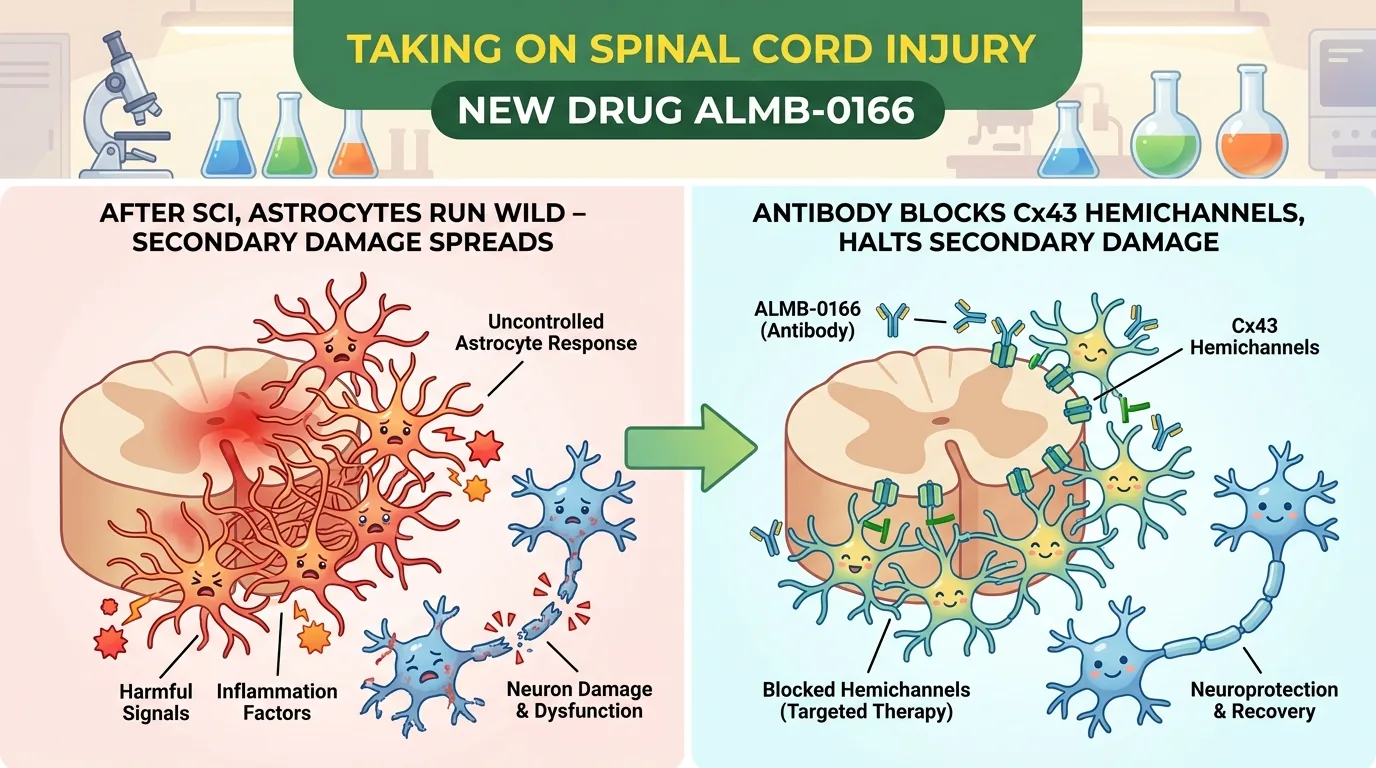
Immediately after the spinal cord is injured in a traffic accident or sports trauma, it is not the initial physical wound itself but the “secondary injury” — which continues to unfold over the following days to weeks — that ends up determining the ultimate functional outcome. One of the leading players in this secondary injury is a protein on the surface of astrocytes (star-shaped glial cells) called connexin43. The paper introduced here reports a Phase I/II clinical trial that actually administered the world’s first antibody drug targeting this connexin43 — ALMB-0166 — to 24 human patients within 72 hours of injury.
Journal Information
- Paper title: “Safety, tolerability and preliminary efficacy of ALMB-0166 in patients with acute spine cord injury” (Safety, tolerability, and preliminary efficacy of ALMB-0166 in patients with acute spinal cord injury)
- Authors: Jinqian Liang (first author, responsible for writing and revising the manuscript) and 16 others. The author list is anchored by clinicians in orthopedics, neurosurgery, and clinical pharmacology at seven sites across China, centered on the Department of Orthopedics at Peking Union Medical College Hospital (PUMCH); six members of the clinical development department at sponsor CSPC Pharmaceutical Group Co., Ltd.; and corresponding author Yanfeng Zhang of developer AlaMab Therapeutics Inc. (Princeton, New Jersey, USA)
- Journal: Brain Communications, 2026, Volume 8, Issue 4, article fcag275
- DOI: 10.1093/braincomms/fcag275
- Impact Factor: 4.5 (the figure Oxford Academic’s journal page states is “based on 2025 data”; CiteScore is 6.7 [2025], online ISSN 2632-1297). Please treat this only as a rough guide
- Publisher: Oxford University Press. A fully open-access medical journal published under the UK neurology charity “Guarantors of Brain,” launched in 2019 as a sister journal to the long-established neurology journal Brain (founded 1878)
- Open access: Yes. Under a CC BY 4.0 license, free to copy, adapt, and redistribute with attribution
- Paper type: Original research article (not a review). A multicenter, randomized, double-blind, placebo-controlled, single ascending dose (SAD) Phase I/II trial
- Peer review timeline: received October 16, 2025 → revised June 11, 2026 → accepted June 29 → published online July 25
- Trial registration: ClinicalTrials.gov NCT05524103
- Funding and conflicts of interest: This trial was funded solely by AlaMab Therapeutics (Shanghai) Inc., developer of ALMB-0166 (a separate legal entity from Princeton-based AlaMab Therapeutics Inc., the affiliation of corresponding author Zhang). Of the 17 authors, 6 are employees of CSPC Pharmaceutical Group Co., Ltd. and 1 (corresponding author Yanfeng Zhang) is an employee of AlaMab Therapeutics Inc., for a total of 7 authors affiliated with industry (discussed in more detail in the fifth section, below)
About the corresponding authors. This paper has two corresponding authors.
Yanfeng Zhang is affiliated with the R&D division of developer AlaMab Therapeutics Inc. (Princeton, New Jersey, USA) and is introduced on the company’s official site under the title “President.” According to that site, Zhang holds a PhD in genetics and biochemistry from Michigan State University and has more than a decade of combined industry and academic experience in protein structure and function, manufacturing, and drug discovery and development. Before joining AlaMab, Zhang served as a director at XBiotech. The antibody technology behind ALMB-0166 was licensed in 2017 from UT Health San Antonio and UT Health Houston. The company’s clinical-stage pipeline consists of two candidates — ALMB-0166 (for spinal cord injury and ischemic stroke) and ALMB-0168, targeting bone-related cancers — and ALMB-0166 received US FDA orphan drug designation in 2018.
Guixing Qiu is affiliated with the Department of Orthopedics at Peking Union Medical College Hospital (PUMCH) and is also an academician of the Chinese Academy of Engineering. Born in 1942 in Wuxi, Jiangsu Province, Qiu graduated from Peking Union Medical College in 1968. Qiu went on to serve as chief of surgery and chief of orthopedics at the hospital, and has held the titles of chief physician, professor, and doctoral supervisor, along with a history of receiving the State Council Special Allowance. Qiu is credited as the proposer of the “PUMC classification” system for scoliosis, and the hospital’s official biography page states that the related research project won a Second-Class National Science and Technology Progress Award. Jinqian Liang, the first author of this paper, is likewise affiliated with the Department of Orthopedics at PUMCH, and the two have been coauthors on scoliosis-related research for more than a decade — this ongoing coauthorship is a clue supporting the identification of this Qiu as the same person who has long been active at PUMCH. It is worth noting that the current chief physician of PUMCH’s Department of Orthopedics is reportedly someone else, and given Qiu’s age and career history, it is presumed that Qiu currently holds a mentoring or honorary role (this point is inference only, and is not explicitly stated in any primary source).
What Was Not Known Until Now?
In acute spinal cord injury (SCI) caused by traffic accidents, falls, or sports, it is not only the “primary injury” — the impact itself destroying nerves — but also the “secondary injury,” which gradually expands the damage over the following hours to weeks, that largely determines how much function ultimately returns. One of the central stages of this secondary injury is connexin43 (Cx43), the protein most abundant on the surface of spinal cord astrocytes.
Under normal conditions, Cx43 functions as a gap junction linking neighboring cells and supports intercellular communication. Once injury occurs, however, Cx43 abnormally opens as a so-called “hemichannel” — a half-formed channel open to the outside of the cell. Through this opening, ATP (adenosine triphosphate), glutamate, and ions leak out, amplifying inflammatory signals such as NF-κB via “crosstalk” between astrocytes and microglia (the resident immune cells of the brain and spinal cord). Excitotoxicity, inflammation, and metabolic stress cascade into one another, and neurons and axons are lost beyond the original damage — a phenomenon known as “bystander injury.”
Elevated Cx43 expression has been confirmed across many settings of central nervous system injury — stroke, epilepsy, ischemia, optic nerve injury, and SCI itself. In mouse experiments, selectively deleting Cx43 in astrocytes has been reported to sharply reduce post-injury ATP release, shrink lesion volume by roughly 50%, suppress glial scar formation, astrogliosis, and microglial activation, and improve motor function recovery (note, however, that this comes from a separate basic-research study using genetically engineered mice, not from ALMB-0166 itself).
👦 Student: So astrocytes, which are supposed to be a protective mechanism, actually end up spreading the damage instead? 🧬 Dr. Exotaro: It’s like the water used to fight a fire ending up flooding the building afterward. When the response meant to put out the original fire (the primary injury) goes too far, it creates secondary damage of its own. What ALMB-0166 aims to do is turn down that “excessive hose water” to an appropriate level.
Every drug used so far in the acute phase of SCI, meanwhile, has had its limits. High-dose methylprednisolone was once expected to have neuroprotective effects, but the window in which it can be given is extremely narrow — within 8 hours of injury — its benefit is limited to improved motor function in only some patients, and it carries serious side effects such as immunosuppression and gastrointestinal complications. For this reason, guidelines from the American Association of Neurological Surgeons (AANS) and the Congress of Neurological Surgeons (CNS) have not recommended methylprednisolone since 2013. Riluzole, known as a treatment for amyotrophic lateral sclerosis, and the antibiotic minocycline have also been tested as candidates, but riluzole carries a burden on the liver and minocycline poses challenges around the complexity of its dosing schedule in real-world clinical use. And no drug directly targeting the human Cx43 hemichannel — anywhere in the world — had ever been approved before now. ALMB-0166 is the first-ever attempt to fill that gap.
What Did This Paper Find?
This trial was a multicenter, randomized, double-blind, placebo-controlled, single ascending dose (SAD) Phase I/II study conducted at seven sites in China. Between July 1, 2022 and October 17, 2024, it enrolled patients aged 18 to 75 with acute SCI at or below the C3 segment, graded B or C on the AIS (American Spinal Injury Association Impairment Scale, an international standard that rates SCI severity on a five-level scale from A [complete injury] to E [normal]), who were scheduled for surgery within 72 hours of injury.
27 patients were screened, 2 did not meet the inclusion/exclusion criteria and were excluded, and 25 were randomized. The 200mg and 600mg groups were assigned to active drug versus placebo at a 2:1 ratio, and the 1200mg, 2400mg, and 4800mg groups at a 3:1 ratio; 1 patient withdrew after randomization without receiving treatment, and in the end 24 patients (17 on active drug, 7 on placebo) received a single intravenous dose, with all completing the trial. This was a step-wise dose-escalation design, in which a Safety Review Committee (SRC) reviewed the safety data at each dose level before deciding whether to advance to the next. Median age was 57.5 years (range 39–74), 70.8% were male, and AIS grade C accounted for 83.3% of participants.
Safety (primary endpoint): Treatment-emergent adverse events (TEAEs — any adverse event occurring after dosing, regardless of whether a causal link to the drug was established) occurred in 94.1% (16/17) of the active-drug group versus 100% (7/7) of the placebo group — the overall incidence was actually higher in the placebo group. Grade 3 or higher TEAEs occurred in 17.6% (3/17; including one case each of hypokalemia, pneumonia, respiratory failure, and deep vein thrombosis) of the active-drug group versus 42.9% (3/7; 2 cases of hypokalemia, 1 of hyponatremia) of the placebo group — again lower in the active-drug group. Of these, treatment-related adverse events (TRAEs, those suspected to be linked to the drug) occurred in 35.3% (6/17) of the active-drug group and 28.6% (2/7) of the placebo group, but every one of them was Grade 1 (mild). There was only one serious adverse event (SAE), a case of deep vein thrombosis in the active-drug group (judged “probably not” related to the study drug); there were none in the placebo group. There were no deaths in either group.
Pharmacokinetics (PK): Across the 200mg-to-4800mg dose range, ALMB-0166 blood concentrations rose gradually from the start of dosing, peaked just before the infusion ended (median Tmax 1.03–2.01 hours), and then declined slowly. Maximum blood concentration (Cmax) rose with dose, from 76.80μg/mL in the 200mg group to 2290.00μg/mL in the 4800mg group, while the elimination half-life stayed nearly constant across the range at 149.86–201.24 hours (roughly 6–8 days). In a power model testing dose proportionality, the β values for Cmax, AUC0-t, and AUC0-∞ were 1.122, 1.088, and 1.084, respectively (each with a 95% confidence interval that included or came close to 1), confirming near-linear pharmacokinetics across the 200mg–4800mg range. Anti-drug antibody (ADA) seroconversion was rare — only one case each in the 200mg, 600mg, and placebo groups — and titers were low, so immunogenicity risk was judged to be low.
| Dose | Cmax (μg/mL) | t1/2 (hours) | AUC0-∞ (h・mg/mL) |
|---|---|---|---|
| 200mg | 76.80 | 201.24 | 9.88 |
| 600mg | 181.75 | 151.66 | 21.01 |
| 1200mg | 575.67 | 193.27 | 85.09 |
| 2400mg | 946.33 | 149.86 | 126.81 |
| 4800mg | 2290.00 | 175.92 | 257.29 |
The half-life (t1/2) is roughly 150–200 hours — about 6–8 days — and stays nearly consistent across doses, showing that even a single dose clears from the body slowly, over several weeks (note that this paper does not specify which blood concentration actually corresponds to the “effective concentration”).
👦 Student: It’s surprising that the placebo group had more side effects than the group that actually got the drug. 🧬 Dr. Exotaro: In small trials, this kind of reversal often happens. What actually matters here is that every side effect seen in the active-drug group stayed mild (Grade 1), with no confirmed rise in serious side effects. This is the stage where the first pieces of evidence for saying “it looks safe” have come together.
Efficacy (secondary endpoints, exploratory): For the sensory score (ISNCSCI), the change from baseline at Day 28 was +62.3 in the 1200mg group and +63.0 in the 2400mg group, versus only +20.6 in the placebo group. Breaking this down further, the pinprick score was +30.0 in the 1200mg group and +32.0 in the 2400mg group versus +8.7 in the placebo group, and the light touch score was +31.3 in the 1200mg group and +31.0 in the 2400mg group versus +11.9 in the placebo group — the active-drug groups outperformed placebo across every sensory modality. The motor score was +53.7 in the 2400mg group versus +34.1 in the placebo group; the upper-extremity motor score was +21.8 in the 200mg group, +19.3 in the 1200mg group, and +24.3 in the 2400mg group versus +11.9 in the placebo group, and the lower-extremity motor score also improved, at +29.3 in the 2400mg group versus +22.3 in the placebo group. For AIS grade recovery, two patients in the active-drug group recovered from Grade C (incomplete paralysis) to Grade E (normal), while no patient in the placebo group recovered to Grade E. The VAS pain score improvement was sustained in the 1200mg group (-40.0 at Day 28, -44.3 at Day 56), whereas the 2400mg group stayed nearly flat (-23.7 at Day 28, -23.7 also at Day 56), and its gap versus the placebo group (-18.9 at Day 28, -20.9 at Day 56) narrowed over time — it should be noted honestly that the 2400mg group, while maintaining strong sensory and motor effects, did not consistently show superiority when it came to pain. In a post hoc analysis pooling the 1200mg and 2400mg groups, nominal p<0.05 (unadjusted for multiple comparisons) was obtained at many time points.
A surprising pattern at the highest dose, 4800mg. Although PK remained linear up to 4800mg and no serious adverse events emerged, the efficacy measures showed a “relative decline” — the 4800mg group actually performed worse than the 1200mg and 2400mg groups. The authors suggest several possible explanations: that suppressing the hemichannel too strongly might disrupt astrocyte homeostasis itself; that excessive exposure might interfere with the gap-junction function that astrocytes and neurons need for support; or that once the pharmacological effect saturates, excessive blockade might instead trigger compensatory inflammatory pathways. The paper itself, however, explicitly states that “these mechanisms remain hypothetical, and further verification is needed to fully clarify how ALMB-0166 acts in SCI,” stopping short of any firm conclusion.
👦 Student: You’d think a higher dose would mean a stronger effect, so why did the effect get weaker at 4800mg? 🧬 Dr. Exotaro: It might be a bit like taking too much painkiller and actually feeling worse. If a door only needed to close partway but you force it fully shut, you end up blocking even the cell-to-cell exchange that was actually needed. I read this as a result showing the risk of “overdoing it.” That’s probably exactly why the authors chose 1200mg and 2400mg, not the strongest dose, as the leads for the next trial.
How Will the Future Change? (The Road to the Clinic)
As the authors themselves state plainly, this trial’s conclusion goes only as far as “recommending 1200mg and 2400mg as the doses to be verified in the next trial.” Weighing safety, efficacy, and PK together, these two doses were chosen as the central doses for the next stage of clinical trials.
This was, after all, only a single-dose, small-sample Phase I/II trial, and it does not translate directly into a treatment. What is needed next is a larger, longer randomized controlled trial that includes multiple ascending dose (MAD) administration, in which a statistical analysis adjusted for multiple comparisons would be conducted again, centered on the 1200mg and 2400mg doses, to substantiate efficacy. Using the current, most up-to-date 2019 ISNCSCI standard rather than the 2000 version used here also remains a task for the future (discussed in more detail in the next section).
If the same trend is confirmed in future large-scale trials, an antibody drug targeting the Cx43 hemichannel could become the first option to fill a niche in acute SCI where “no approved drug has ever existed.” A design that can be delivered as a single infusion to patients scheduled for surgery within 72 hours of injury is also practical to work with. That said, the SCI field already has other antibody drugs, such as anti-Nogo-A antibodies, that have advanced as far as Phase II trials, and ALMB-0166 should be positioned as one entrant among these challengers.
What should not be forgotten is that although the eligibility criteria — “SCI at or below the C3 segment” — were set broadly enough to potentially include thoracic and lumbar injuries, all 24 patients actually enrolled had cervical injuries at C3–C7. So whether these results can simply be extended to thoracic- or lumbar-level injuries cannot be judged from this data alone. In terms of distance to approval as well, this was, after all, only an early, single-dose trial conducted at seven sites in China; for it to actually become a drug usable in clinical practice, several more years’ worth of stages — MAD trials, large-scale confirmatory trials, and applications to regulatory authorities in each country — still lie ahead.
👦 Student: Does this mean it can already be used in hospitals now? 🧬 Dr. Exotaro: Not yet. This is only the stage of gaining the first clues that “it looks like it can be used safely” and “it looks like it has an effect.” Before it can actually be approved as a treatment, much larger confirmatory trials than this one need to be repeated, and it has to pass regulatory review. It’s accurate to view this result as “the first step” on that long road.
How to Read This Study Critically (Limitations, and the Road to Better Quality)
Let me first note what should be credited. A design that prioritizes safety above all, incorporating stepwise dose escalation and case-by-case judgment from a Safety Review Committee, is appropriate for an early trial in vulnerable, acute-phase SCI patients. Adverse events, PK, immunogenicity, and efficacy measures are all reported carefully based on clearly defined analysis sets, and the authors themselves frame the results as “preliminary,” avoiding overreaching conclusions.
That said, there are several points worth flagging honestly.
First, funding and conflicts of interest. This trial was funded solely by AlaMab Therapeutics (Shanghai) Inc., developer of ALMB-0166; of the 17 authors, 6 are employees of CSPC Pharmaceutical Group Co., Ltd. and 1 (corresponding author Yanfeng Zhang) is an employee of AlaMab Therapeutics Inc. (7 in total). This is disclosed in the paper itself as a conflict of interest, and it is an entirely common arrangement for early-stage industry trials — it does not by itself imply misconduct. Still, readers should keep in mind the possibility that the funding source and the interpretation of the results are not fully independent.
Second, reliance on “unpublished data.” ALMB-0166’s efficacy in a mouse SCI model, its binding to astrocytes derived from mouse, rat, monkey, and human tissue, repeat-dose toxicity studies in mice and cynomolgus monkeys, and a Phase I trial in healthy volunteers conducted in Australia (n=28, TEAEs in 42.9%) — all of these are cited in the paper only as “unpublished data,” have not been peer-reviewed or published as independent papers, and cannot be verified by any third party. It should be stated plainly that much of the safety foundation underlying this early human trial rests on this unpublished data.
Third, six limitations the authors themselves state explicitly. (1) This is a single ascending dose (SAD) design, so safety under repeated dosing is unknown; (2) the follow-up period is only 56 days, too short to assess long-term adverse events or the durability of effect (though it does cover several multiples of the half-life); (3) the number of cases in each dose group is small, at 3–4 (7 in the placebo group), and no power calculation was performed, so the efficacy figures are only preliminary; (4) the ISNCSCI standard used for assessment was the 2000 version, not the revised 2019 version; (5) the VAS score analysis was not adjusted for the effects of concomitant analgesics; and (6) given all of the above, a larger, longer MAD trial using the 2019 ISNCSCI standard is needed.
👦 Student: But if it says “p<0.05,” doesn’t that mean the effect has been statistically proven? 🧬 Dr. Exotaro: Think of it like drawing many lottery tickets and then only reporting the “winning combinations” you found. This isn’t a p-value that tested one hypothesis decided in advance — it’s a “nominal p<0.05” found by comparing many measures and time points after the fact. Genuine proof requires a confirmatory trial in which the number of comparisons is fixed beforehand and a statistical correction is applied.
I also want to stress that the efficacy figures themselves are an exploratory result based on nominal p-values from post hoc analysis (unadjusted for multiple comparisons), not confirmatory statistical proof. The sensory and motor score improvements in the 1200mg and 2400mg groups are numerically clear, but in that same 2400mg group, pain (VAS) improvement stayed nearly flat at -23.7 on Day 28 and still -23.7 on Day 56, with the gap versus the placebo group (-18.9 → -20.9) narrowing over time — rather than lining up only the favorable numbers, we should evaluate this study including such inconsistencies as well. Further improvements in quality will require a larger, longer repeat-dose (MAD) trial, adoption of the 2019 ISNCSCI standard, a statistical analysis plan with multiple comparisons adjusted in advance, and, if possible, replication of the data from an independent funding source.
Dr. Exotaro’s Perspective
What I myself have worked on for years is a regenerative-medicine approach that uses mesenchymal stem cells (MSC) and their extracellular vesicles (EV) to “nurture” nerves after spinal cord injury. ALMB-0166 tackles the same problem from a completely different direction. Rather than creating new nerve tissue or promoting repair, the idea is to calm the inflammatory response of astrocytes themselves as they run out of control in the hours to days right after injury.
I actually think this difference makes the two approaches a rather good fit for each other. The acute phase of SCI is a period when the top priority is “preventing the damage from spreading any further,” and a drug like ALMB-0166, which suppresses ATP and glutamate leakage through the Cx43 hemichannel and the inflammatory cascade early on, plays the role of “firefighting to stop the blaze from spreading.” Meanwhile, the MSC-derived EVs I have worked on take on the role of “rebuilding from the ashes” during the subacute-to-chronic phase, once inflammation has settled, through axon elongation, angiogenesis, and the secretion of neuroprotective factors.
Of course, no clinical evidence currently exists anywhere showing that a treatment combining these two approaches would actually work. I want to be honest that this is strictly a hypothesis based on mechanism of action, and nothing more than my own personal hope. Even so, I think the idea of linking acute-phase anti-inflammatory neuroprotection with regenerative medicine in the subacute phase and beyond, along a single timeline, is a plausible direction for the future of SCI treatment. I will continue watching closely to see how far ALMB-0166 can establish its efficacy in future large-scale trials, and where our own MSC-EV research might be able to bridge the gap.